
Nikon F Review (2026): Shooting the Indestructible 35mm Legend
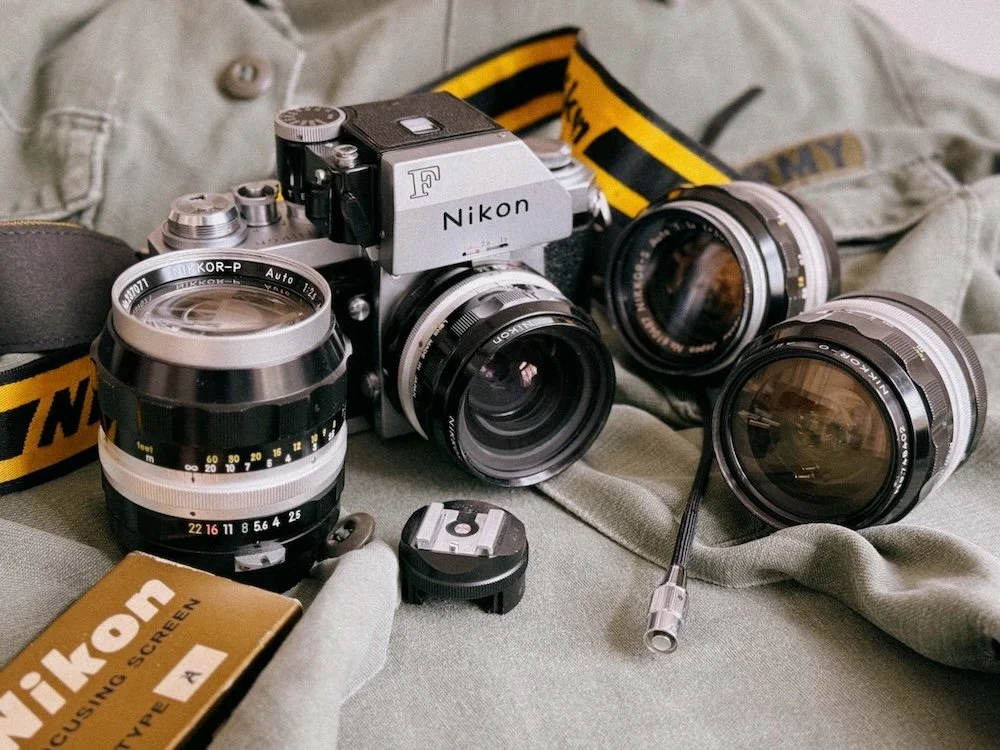
Nikon F Photomic FTN – a masterpiece
Reading Time: 7 Minutes
A lot of photographers consider the Nikon F the most important 35mm film camera ever made. Introduced in 1959, it defined the professional SLR system and remains highly usable in 2026 thanks to its fully mechanical design and legendary Nikon F-mount.
TL;DR: Nikon F at a Glance
Camera Type: Fully mechanical 35mm SLR
Launch Year: 1959 (helped replace rangefinders)
Lens Mount: Nikon F-mount (60+ years of Nikkor lenses)
Key Features: All-metal build, 100% viewfinder, titanium shutter
Power: No battery needed (meter requires Photomic finder)
Best For: Experienced film photographers & collectors
Not For: Beginners or users expecting automation
Why I Bought the Nikon F (From Rangefinder to SLR)
Like many people out there, I was one of those who started with a rangefinder because of the Leica hype. But about a year later, I was lusting for somehting different. Not just because I wanted to be able to shoot something other than 50mm lenses on my Canon P rangefinder, but because I was looking for a new experience. I also wrote a complete comparison of the two. You can find it here.
After some research, I came across the Nikon F: often cited as the first-ever professional SLR system. This camera had a certain rebellious appeal to it, probably due to movies like Apocalypse Now, where Dennis Hopper plays a nameless photographer. This character combined with that 60s vibe was so intriguing that I had to get one for myself.
First Impressions: Nikon F Photomic FTN in Hand
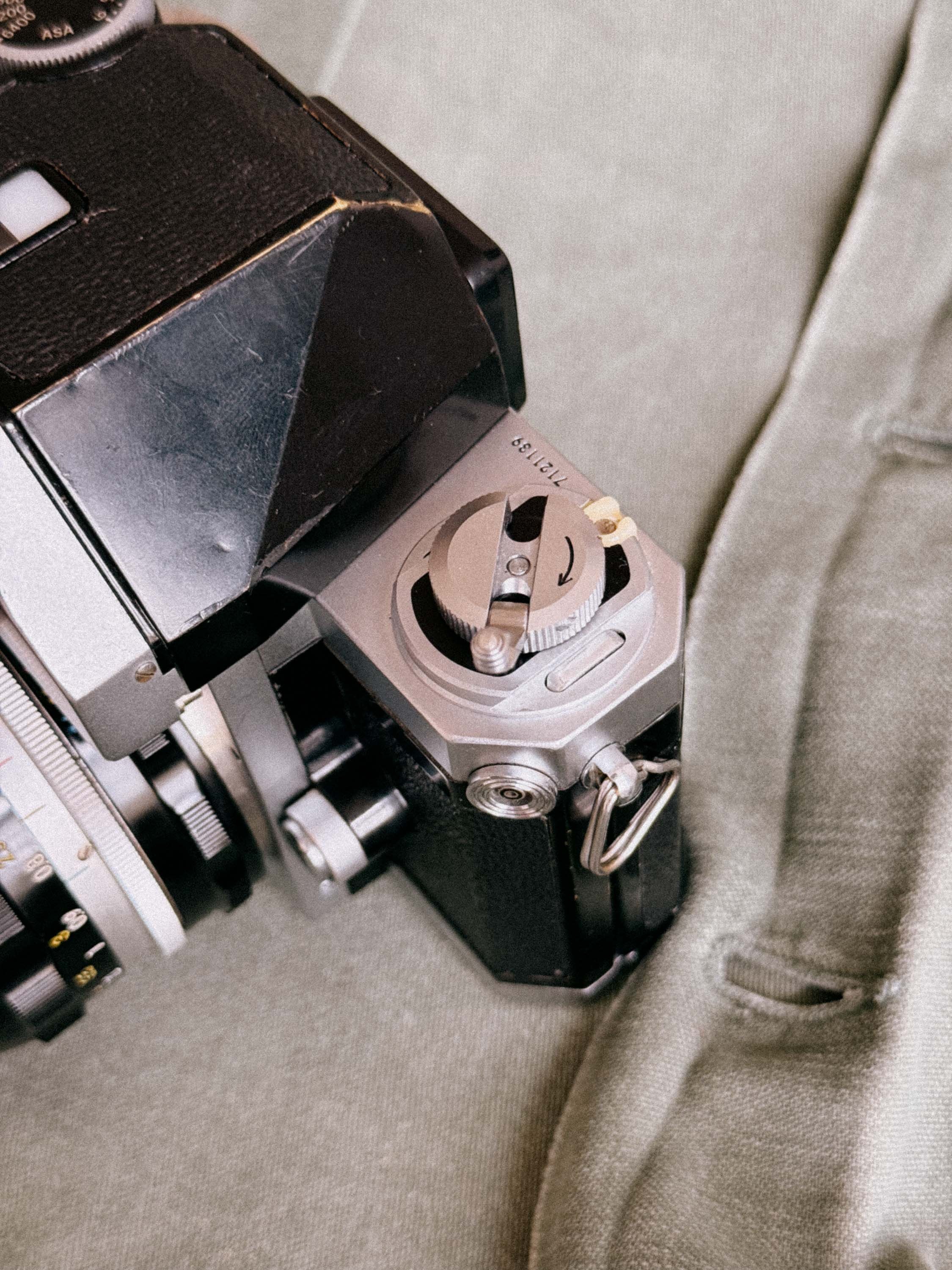
Nikon F - Rewind Crank and PC-Sync
When my Nikon F Photomic FTN arrived from Japan at my doorstep, I was in for a surprise. In combination with the Pre-AI 50mm f/1.4, the look and tactile experience were just something else. It made me instantly realize why not only war photographers but also journalists in the 60s chose this model. It’s a tank offering the precision of a clockwork.
CLA Service & Long-Term Reliability
I just had a full CLA (clean lubricate adjust) service done by Kamera Service Hoffmann in Stuttgart, not because something was broken, but simply out of love for the camera. I want to enjoy it for many more years to come. So, strap on your boots for this Nikon F review.
Nikon F Review Contents (Quick Navigation)
The Nikon F History: From Nippon Kogaku (1917) to Rangefinder Kings
The Camera That Changed Everything (1959)
Forged in Combat: The Nikon F in the Vietnam War
Nikon F Technical Specifications: The 1959 Blueprint
Build Quality & Mechanics of the Nikon F: The "Hockey Puck" Philosophy
Viewfinders: The Modular Eye of the Nikon F
The Secret Weapon: Interchangeable Focusing Screens
The Heart of the Nikon F: F-Mount & The Magic of Pre-AI Lenses
Nikon F Shooting Experience: Ergonomics and Quirks
The Ultimate Pre-AI Lens Kit for the Nikon F
Nikon F Buying Guide & Service: Keeping it Alive
Nikon F: Frequently Asked Questions (FAQ)
Final Verdict: Is the Original Nikon F Still Worth It?
Quick Summary: Nikon F Pros & Cons in 2026
| Pros | Cons |
|---|---|
| Indestructible Build: Built like a tank with a legendary titanium foil shutter. | Handling Quirks: The fully removable back makes film loading slow and clunky. |
| 100% Viewfinder: What you see is exactly what you get on the negative—no surprises. | Weight: It’s a heavy piece of solid metal (approx. 1kg with a lens). |
| Pre-AI Lens Paradise: The best body to use affordable, high-quality vintage "Non-AI" glass. | No Internal Meter: Unless you use a (often bulky or dead) Photomic finder. |
| Fully Mechanical: Works without batteries; perfect for long-term reliability. | Ergonomics: No built-in grip and a non-standard cold shoe for flash. |
| Modular System: Interchangeable finders and screens for any shooting style. | External Sync: Requires a special adapter for standard PC-sync or flash use. |
The Nikon F History: From Nippon Kogaku (1917) to Rangefinder Kings
Before we can talk about the "F", we have to talk about Nippon Kogaku K.K. Established in 1917, they weren't originally a camera company, they were an optical powerhouse. In the early days, they even manufactured lenses for other brands (including the very first Canons).
After WWII, Nikon shifted focus to their own bodies, leading to the legendary Nikon S-series rangefinders. By 1957, they had reached the pinnacle with the Nikon SP, a camera so advanced it rivaled the Leica M3. Nikon was a rangefinder company through and through, and this heritage is the secret sauce of the Nikon F.
The Shift from Rangefinder to SLR
When Nikon released the Nikon F in June 1959, they didn't just launch a new product; they almost drove Leica into bancruptcy. But the genius of the Nikon F wasn’t that it invented new technology out of thin air. Instead, it was born in the genius of integration.
Nikon took elements that already existed in various forms, the SLR mirror, the focal plane shutter, interchangeable finders, and combined them into one rugged, cohesive, and professional-grade system. As the official Nikon Chronicle states:
"The Nikon F was developed with the goal of creating the ultimate SLR camera, incorporating every possible feature a professional photographer could need."
The Nikon SP Connection
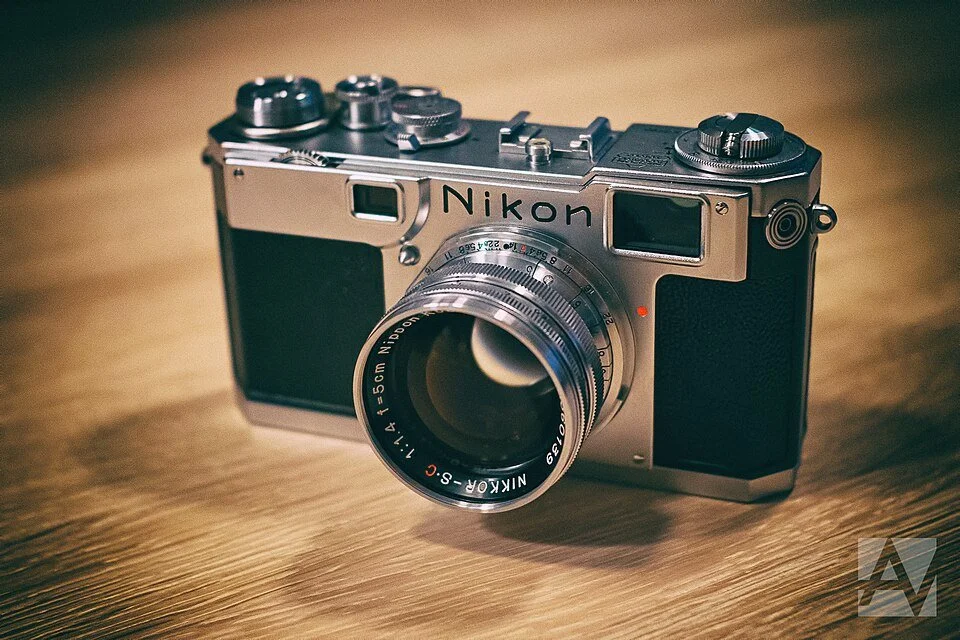
Nikon S2 with its matching 50mm F/1.4
If you look closely at a Nikon F in 2026, you can still see the rangefinder DNA of its older siblings like the Nikon SP (1957) or Nikon S3 (1958) staring back at you. The body casting, the shutter mechanics, and even the removable back are direct descendants of the Nikon SP. Nikon basically took their most reliable rangefinder, "widened" it, and integrated a mirror box in the middle.
The Camera that Changed Everything (1959)
This hybrid heritage is exactly why the F felt so familiar to professionals in 1959, yet offered a revolutionary way to see through the lens. It was the birth of a system that would dominate the next 50 years of photography.
The Birth of the F-Mount: A Design for Eternity
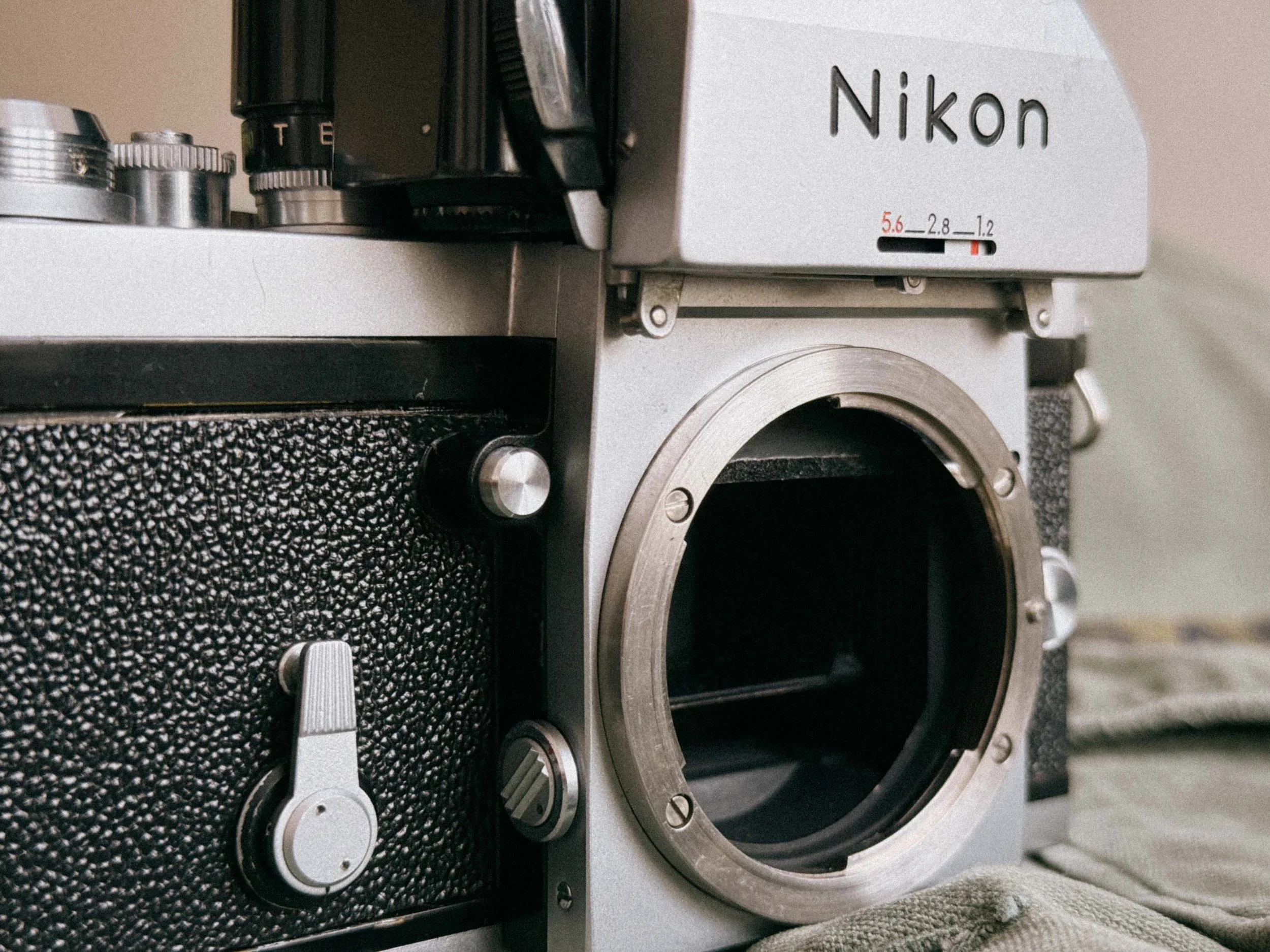
Nikon F Mount - Your Gateway to Great Lenses
When Nikon introduced the F-mount in 1959, they didn't just design a lens attachment. The mount was revolutionary for its time, featuring a large internal diameter that allowed for fast lenses (like the legendary 50mm f/1.4) and a robust three-lug bayonet system.
This decision allowed Nikon users to access a massive selection of lenses spanning over six decades. However, the true magic of the original Nikon F is its pure compatibility. Unlike modern Nikon DSLRs, the F has no "AI-indexing tab" on the camera body that could be damaged. This makes the Nikon F the ultimate native home for Non-AI (Pre-AI) lenses. Which great cause they are mostly cheaper!
Note: While these vintage "Nippon Kogaku" lenses are affordable and optically stunning, there are specific compatibility rules when mounting them on modern digital bodies or later film cameras like the F4 or F100. Let me know in the comments if you want a deep dive on navigating the Pre-AI vs. AI-S lens maze!
Forged in Combat: The Nikon F in the Vietnam War
When I think of the Nikon F, I hear "Fortunate Son" by CCR in my head while being on board a Bell UH-1 helicopter over Vietnam in the late '60s. I’ve probably seen too many war movies, but this image is not solely created by pop culture. If you look into the history books, so many important, and sometimes horrible, moments of human achievement and cruelty in modern photojournalism were captured with this exact camera.
The Nikon F became the standard-issue tool for war photography. This includes what many consider the most iconic picture of the Vietnam War: Eddie Adams’ photo of South Vietnamese General Nguyen Ngoc Loan shooting Vietcong officer Nguyen Van Lem. The Nikon F didn’t just capture death; it also prevented it. Don McCullin’s life was saved when an AK-47 bullet was deflected by his combat-proven Nikon F. It’s a testament to its legendary durability.
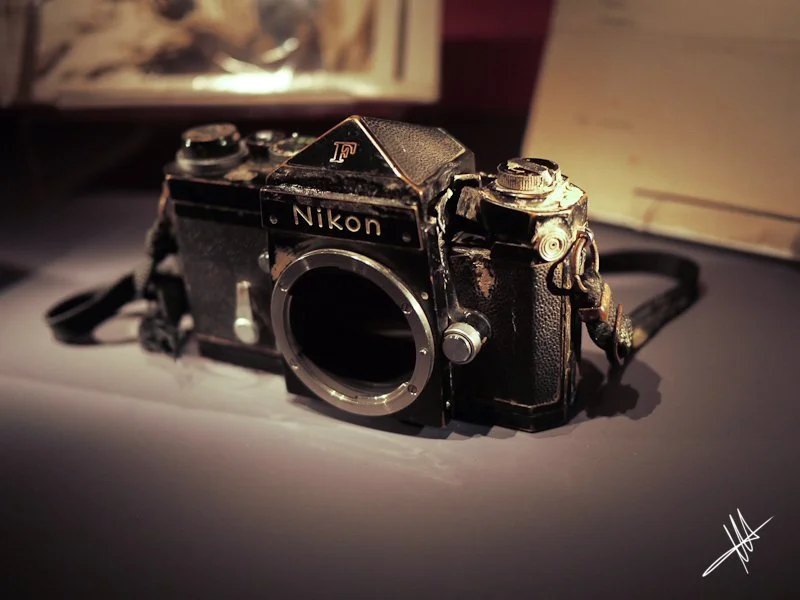
But it was also the camera of the jet set: the Beatles, Mick Jagger, and Marilyn Monroe. This camera has seen it all. From the dirt of the jungle to the glamour of the stage alike and space itself.
Nikon F Technical Specifications
To understand why this camera was a revolution, you have to look at the specs. In 1959, these specs weren't just "good"—they were the standard that every other manufacturer tried to chase for the next decade.
| Feature | Specification |
|---|---|
| Camera Type | 35mm Single Lens Reflex (SLR) |
| Introduction Year | 1959 (Produced until 1973/74) |
| Lens Mount | Original Nikon F-Mount (Non-AI / Pre-AI native) |
| Shutter Type | Horizontal-travel, focal-plane shutter |
| Shutter Material | Legendary Titanium Foil (Early models had cloth) |
| Shutter Speeds | 1 second to 1/1000 sec, plus Bulb (B) and Time (T) |
| Viewfinder Coverage | 100% accurate (What you see is what you get) |
| Interchangeable Finders | Standard Prism, Photomic (T, Tn, FTN), Waist Level, Action Finder |
| Focusing Screens | 17 interchangeable types (Type A, J, K, etc.) |
| Flash Synchronization | X-sync at 1/60 sec (via PC sync or cold shoe adapter) |
| Film Advance | Single-stroke lever (can be used with F-36 motor drive) |
| Mirror Lock-Up | Yes (Manual, requires firing one blank frame to engage) |
| Self-Timer | Variable delay (approx. 3 to 10 seconds) |
| Depth of Field Preview | Yes (Dedicated button next to the lens mount) |
| Film Loading | Removable back (The "Hockey Puck" style) |
| Dimensions (Body only) | Approx. 147 x 98 x 56 mm |
| Weight (Body only) | Approx. 685g (approx. 1kg with FTN Finder and 50mm lens) |
Why these specs still matter in 2026
- The 100% Viewfinder: Even many modern DSLRs and mirrorless cameras don't offer a true 100% view. With the Nikon F, there are no surprises at the edges of your frame.
- Titanium Shutter: Unlike cloth shutters, the titanium foil is nearly indestructible and won't develop pinholes if you accidentally leave the camera pointing at the sun without a lens cap.
- Mirror Lock-Up (MLU): This was a world-first for a mass-produced SLR. It allows for vibration-free long exposures and is required for some early ultra-wide lenses that protrude deep into the body.
Build Quality & Mechanics: The "Hockey Puck" Philosophy
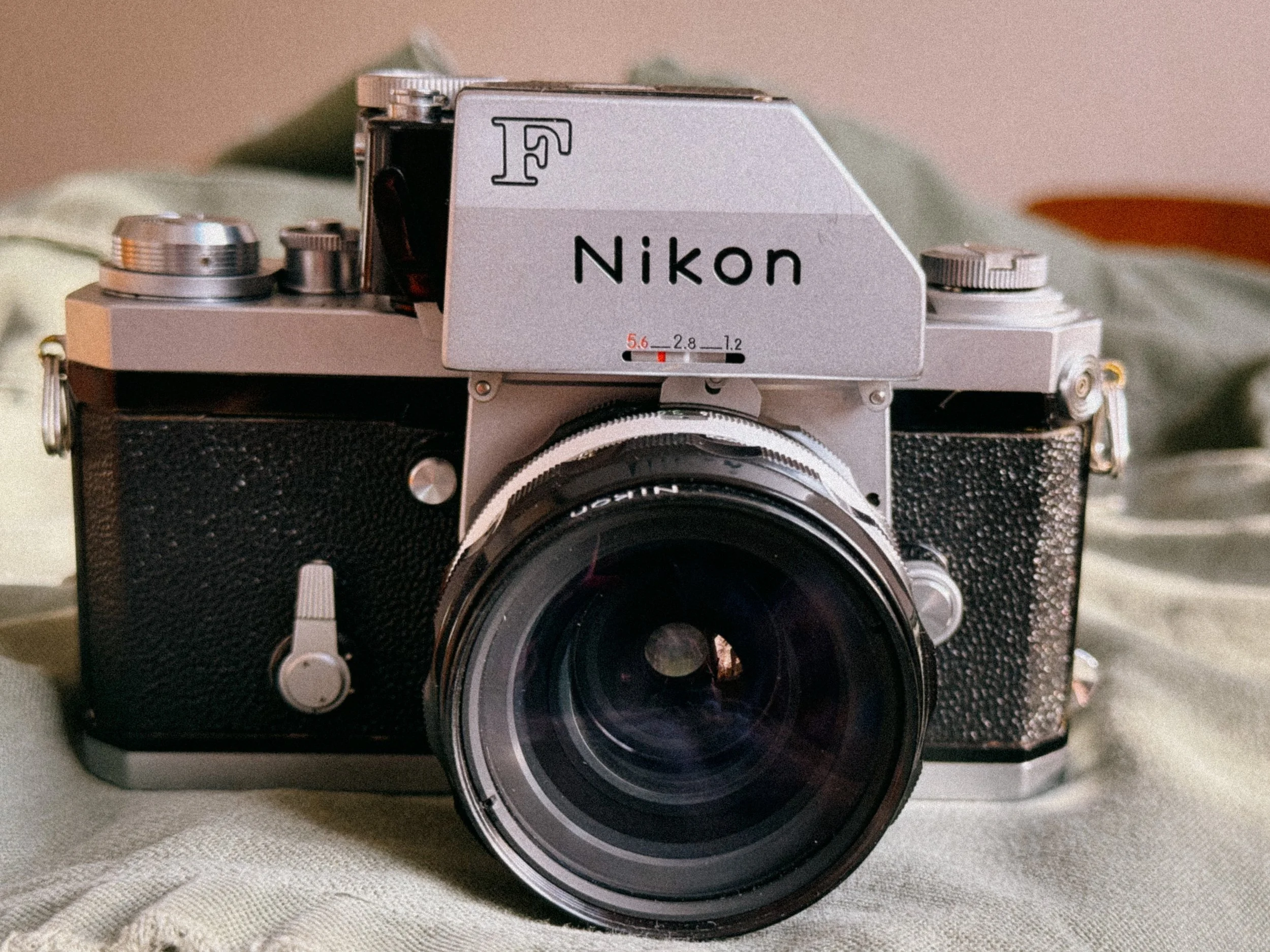
It’s sturdy!
If you pick up a Nikon F for the first time, you instantly understand why photographers affectionately nicknamed it the "Hockey Puck." There is absolutely no plastic here. Designed during the golden era of Nippon Kogaku, the camera feels like it was milled from a single, solid block of brass. Weighing in at nearly a kilogram with a lens and the Photomic finder attached, this fully mechanical SLR doesn't just feel like a tool for photography; it’s so sturdy you can drive nails with it or use it for self-defense.
The Titanium Focal Plane Shutter
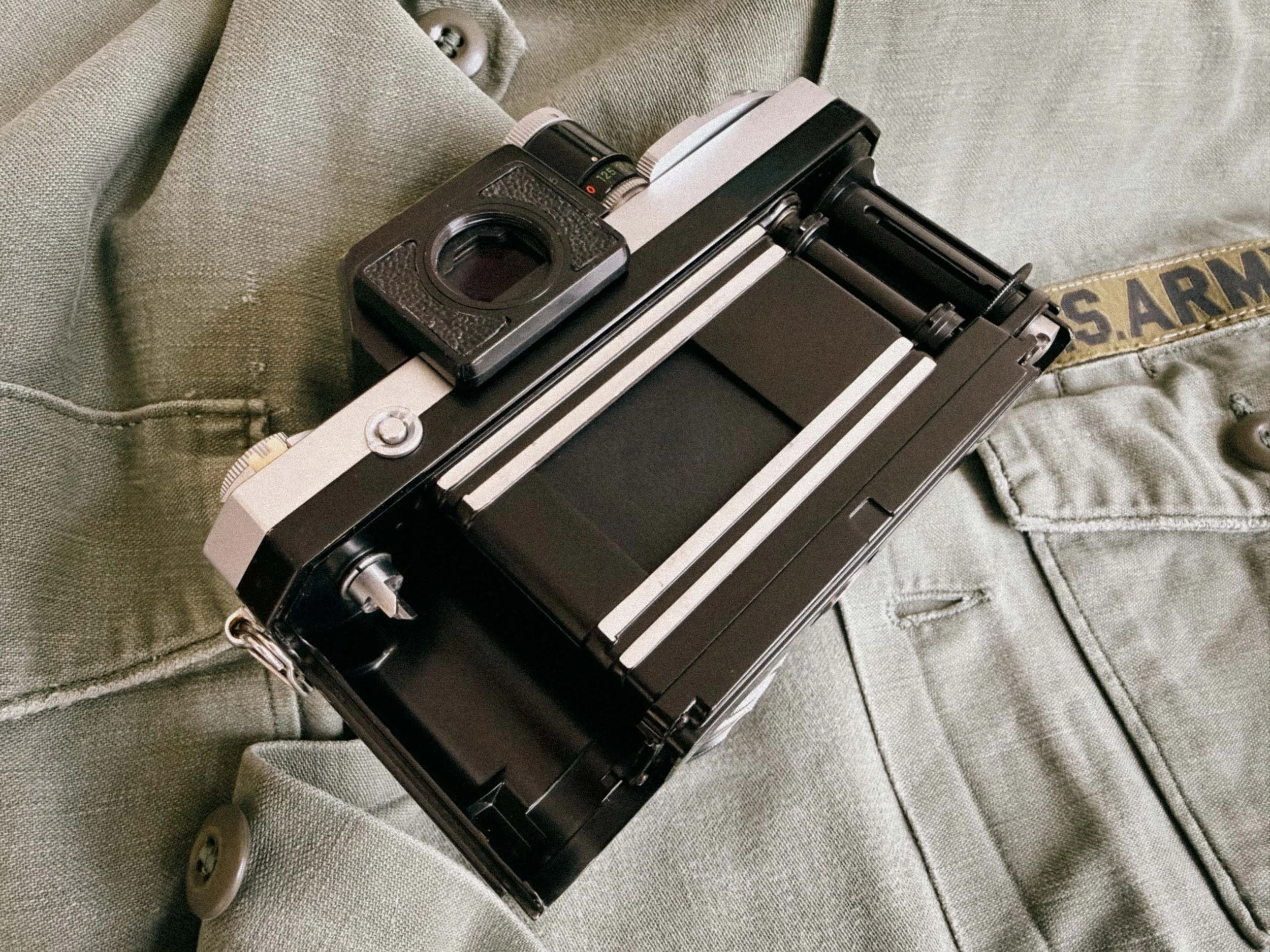
The Nikons Titanium Shutter
The heart of its bulletproof reputation is its shutter. While most cameras of the late 1950s and 60s, Leicas, relied on rubberized cloth curtains, Nikon took a massive leap and installed a titanium focal plane shutter. Why does this matter today? Because cloth shutters can easily burn pinholes if you accidentally leave your lens pointing at the sun without a cap. The titanium foil of the Nikon F just shrugs that off, ensuring long-term mechanical reliability. Originally tested for an unprecedented 100,000 actuations, this shutter provides a loud, satisfying metallic "clack" when fired. It’s a great sound with unparalleled tactile feedback that other mirrorless cameras simply cannot replicate.
Viewfinders Explained: Eye-Level Prism vs. Photomic
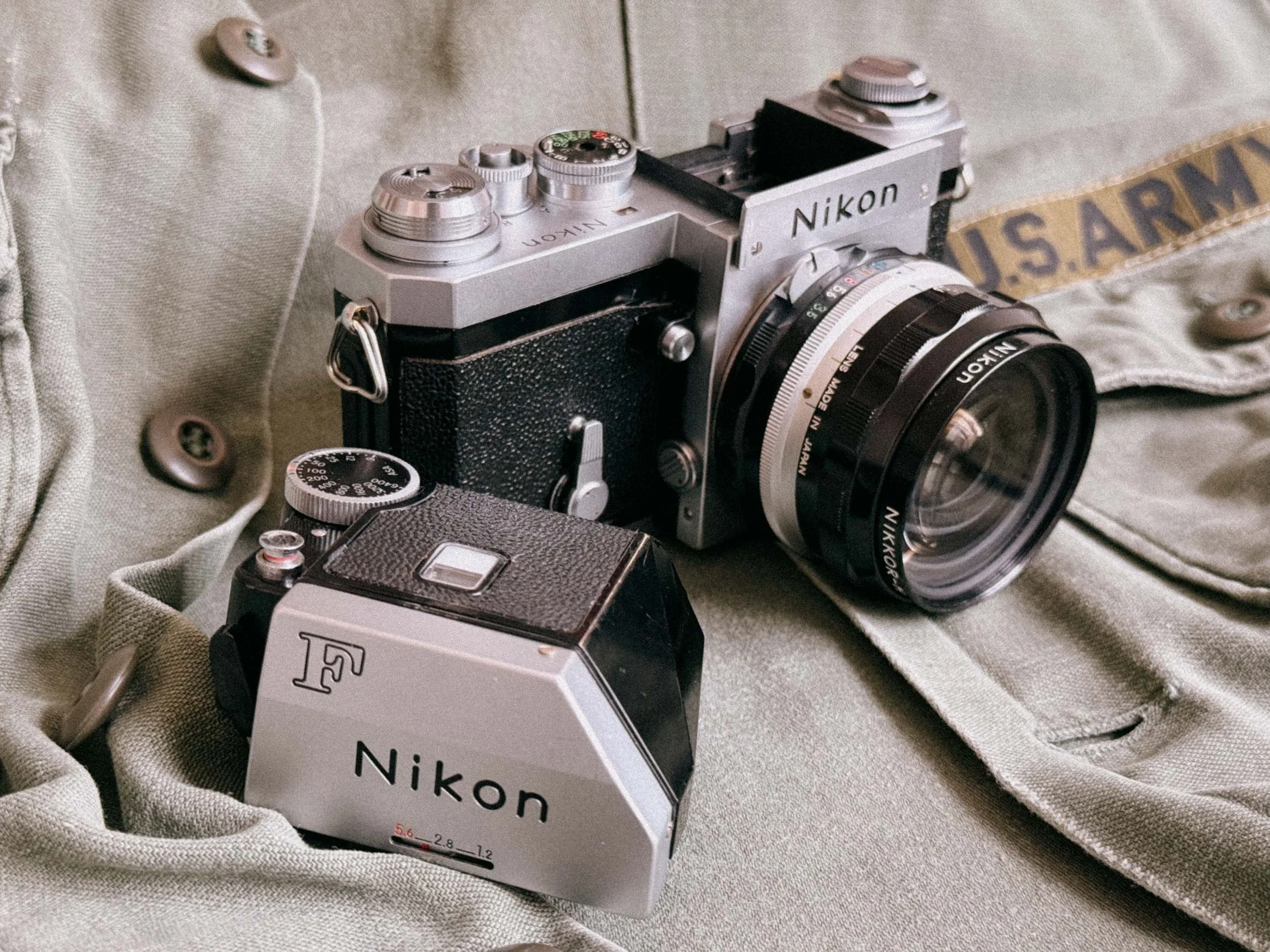
The Photomic FTN next to the Nikon F Body
One thing that sets the Nikon F apart is that it is a true system camera, designed to use different finders and accessories. At its release in 1959, the Nikon F originally shipped with a simple, beautiful non-metered prism (Ironically those are now the most “sought after” finders). So yes, the body of the camera itself does not have a light meter built in.
The very first meters were actually clip-on selenium meters that attached over the shutter speed dial and the standard prism. There were three different versions of these available before Nikon took the next big step.
In 1962, the first metered finder, the original Photomic, was introduced. This cemented Nikon's philosophy of non-obsolescence: instead of buying a whole new camera to get new technology, you could simply swap out the finders. These finders "communicate" with the camera body by sitting on top of the shutter speed dial, while a mechanical arm connects to the typical "rabbit ears" (the metal prong) on the Nikkor lenses to “read” the aperture.
The Photomic Evolution

A peek through the FNT Viewfinder
The original Photomic (1962) did not feature through-the-lens (TTL) metering. Instead, it had its own built-in "eye" metering lens on the front. You could even screw in telephoto attachments (to compensate for longer focal lengths) or an incident light attachment. There were three different variations of this early model, including the famous "flag" version. The meter settings were read externally through a little window on top of the finder.
The second iteration, the Photomic T (1965), got rid of the extra external metering lens of its predecessor and finally introduced true TTL (Through-The-Lens) metering. It was a much more reliable averaging meter that read the light actually hitting the mirror.
In 1967, Nikon introduced the Photomic TN finder. Here, they shifted from an average reading to center-weighted metering (concentrating 60% of the sensitivity in the center of the frame), which became a Nikon standard for decades.
The final iteration, introduced in 1968, is the legendary Photomic FTN. This is arguably the best and most advanced version of them all. Not only did it keep the excellent center-weighted metering, but the shutter speed was now visible directly inside the viewfinder. It also introduced semi-automatic aperture indexing, meaning you just had to mount the lens and twist the aperture ring back and forth once (the famous "Nikon shuffle") to sync the meter, rather than adjusting it manually.
Beyond the standard eye-level and Photomic prisms, the Nikon F offered a range of specialized viewing options. The Action Finder allowed photographers to see the full frame while wearing goggles or diving masks. Then there is the Waist Level Finder, which lets you look down into the camera from above for a more "Rolleiflex-style" experience.
Specialist Finders, battery and de-silvering problems
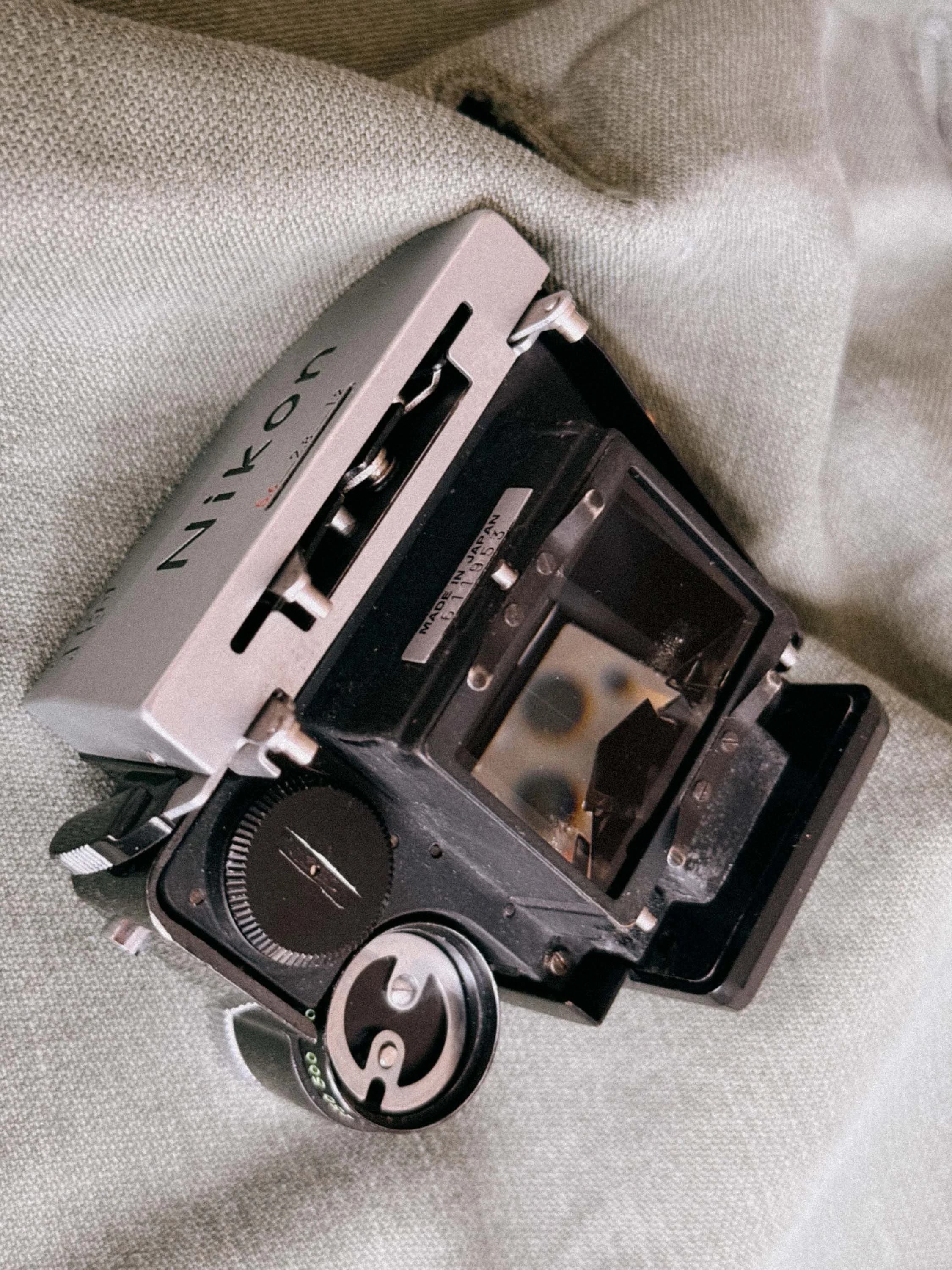
The rotten foam has already had its share of this prism
However, choosing a metered finder today comes with a hurdle: the power source. All Photomic finders were designed to run on PX625 1.35V Mercury batteries. While modern 1.5V alkaline versions exist, they provide the wrong voltage, leading to inaccurate light meter readings.
Luckily there is a fix! “Ausgeknipst” offers a great adapter that keeps the meter working in order and i wrote a review. Read it here.
Many of these 60-year-old meters have simply died over the decades. They often suffer from prism desilvering, where the internal coatings deteriorate, leaving dark spots or lines in your view.
More on that when we talk about maintenance later.
The Secret Weapon: Interchangeable Focusing Screens
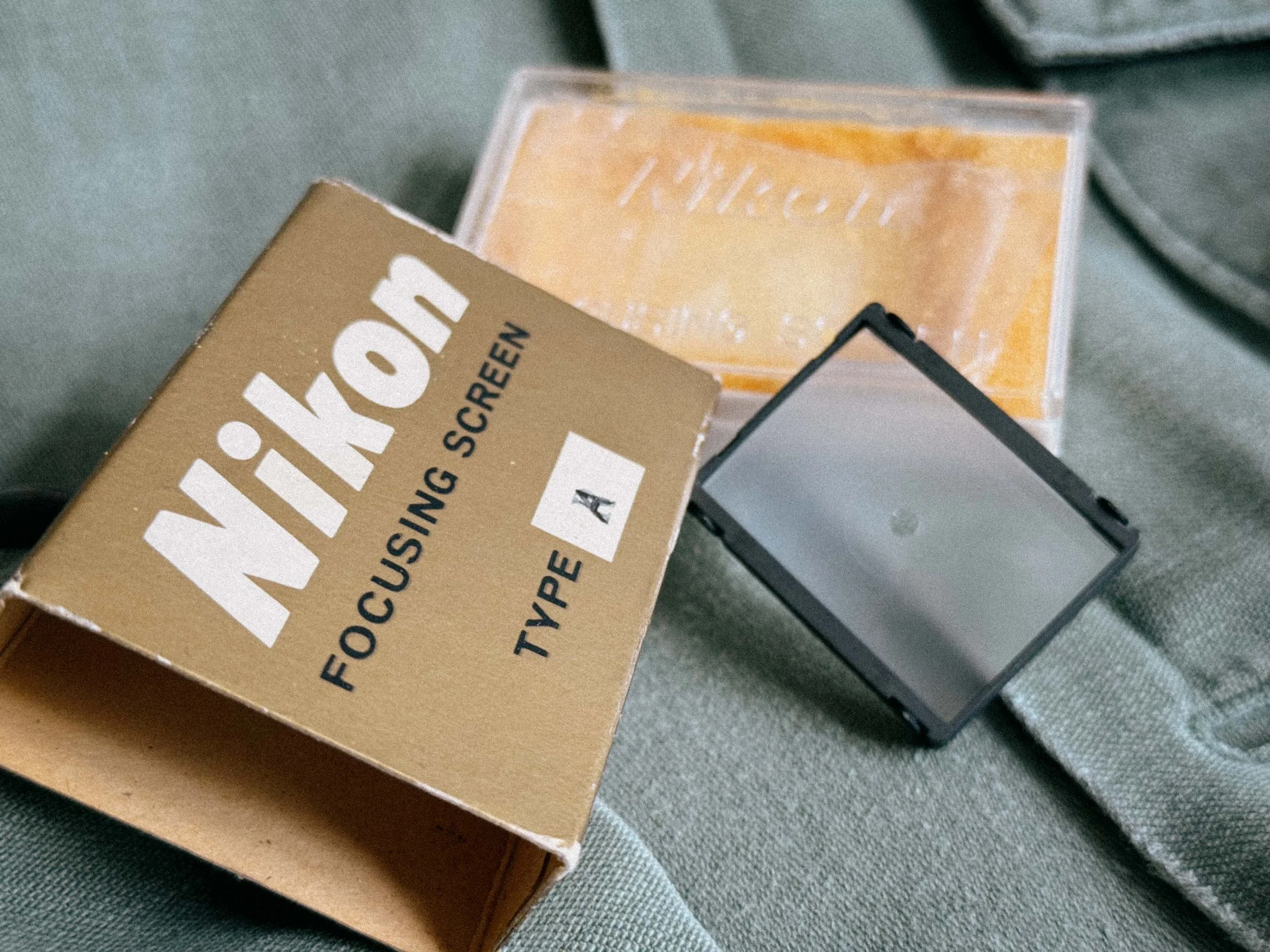
Focusing Screen Type A
While other cameras require a trip to a technician to change a screen, the Nikon F was designed as a modular system. There are 18 (later up to 22) different types of screens available. Look at this excerpt from the original instruction manual. As the document illustrates, Nikon didn't just offer one or two generic alternatives; they engineered highly specific tools for every photographic discipline.
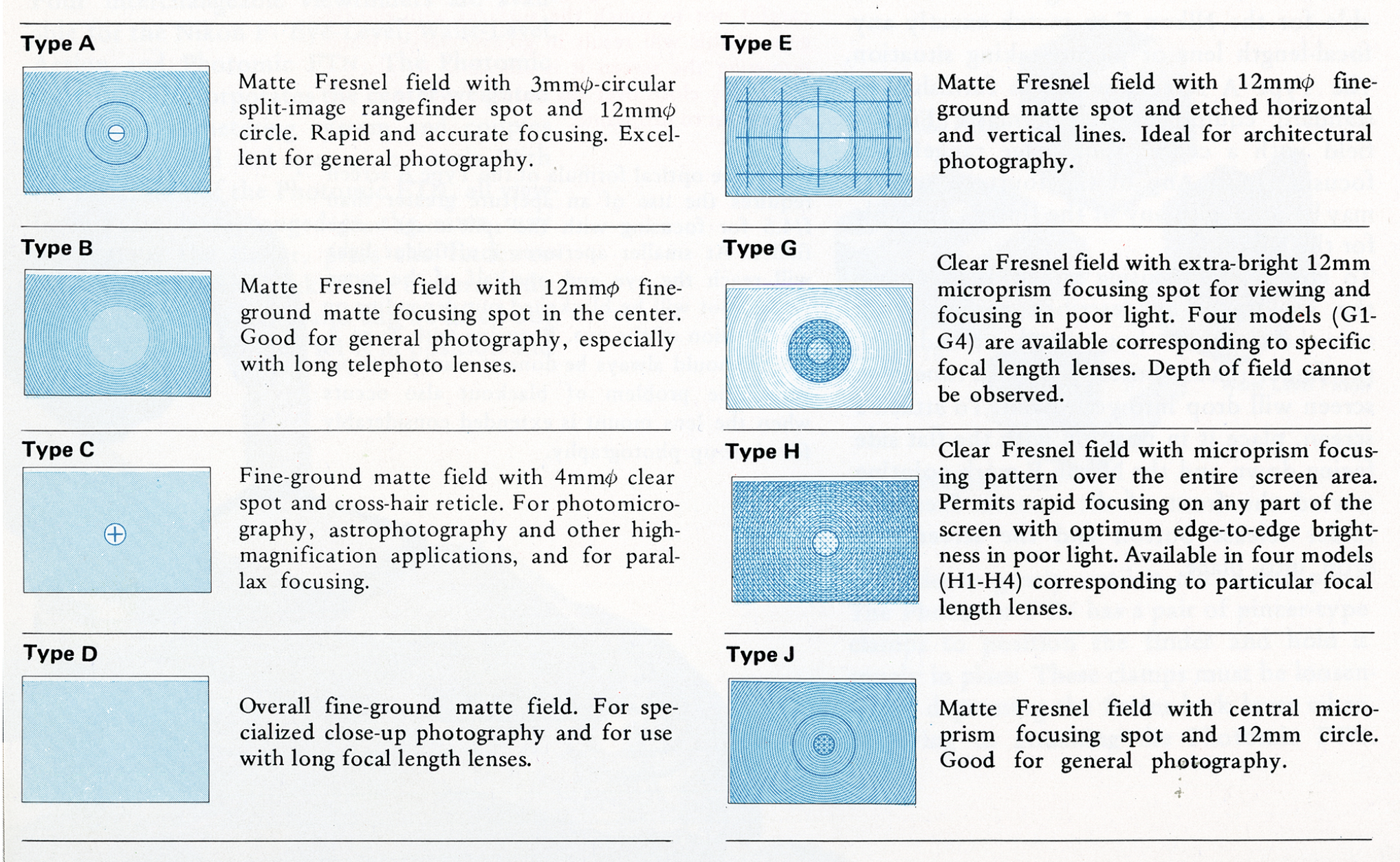
The 8 screens available at introduction, many more were added later.
Image source: Excerpt from the original Nikon F Instruction Manual (Copyright: Nikon Corporation). Screenshot retrieved from: https://old-cameras.com/2024/04/nikon-f-instruction-manual/4/Standard (Type A ): Most bodies come with Type A (horizontal split-image) or the more modern Type K (split-image plus a microprism ring). These are excellent for 95% of general photography.
Architecture (Type E): As you can see it’s a plain matte screen but with an etched grid. It’s perfect for architectural shots, keeping horizons perfectly level in street photography, and the "Rule of Thirds."
Portrait (Type P) not shown above: Known as the "Apollo" screen, it features a 45° diagonal split-image. This is genius for portraits because you can focus on vertical and horizontal lines (like eyelashes or glasses) without needing to tilt the camera.
Low Light & Telephoto (Type B): If you use "slower" lenses like the 28mm f/3.5 in low light, a split-image can often "black out" on one side. The Type B (plain matte) is much brighter and easier to use in dim conditions or with long telephoto lenses.
Buying Tip: When browsing eBay or local shops, check which screen is installed. A scratched Focusing Screen isn't a dealbreaker. Swapping them is effortless: Remove the viewfinder, press the release button, flip the camera over, and the screen drops right out.
The Heart of the System: F-Mount & The Magic of Pre-AI Lenses
The Nikon F has one massive mechanical benefit: it lacks the fixed auto-indexing (AI) tab found on almost all later bodies. Even on the later Nikon F2, specifically the F2A and F2AS models, you have to be extremely careful because their AI-indexing tabs can be damaged by older glass. But the original Nikon F? It simply doesn't care.
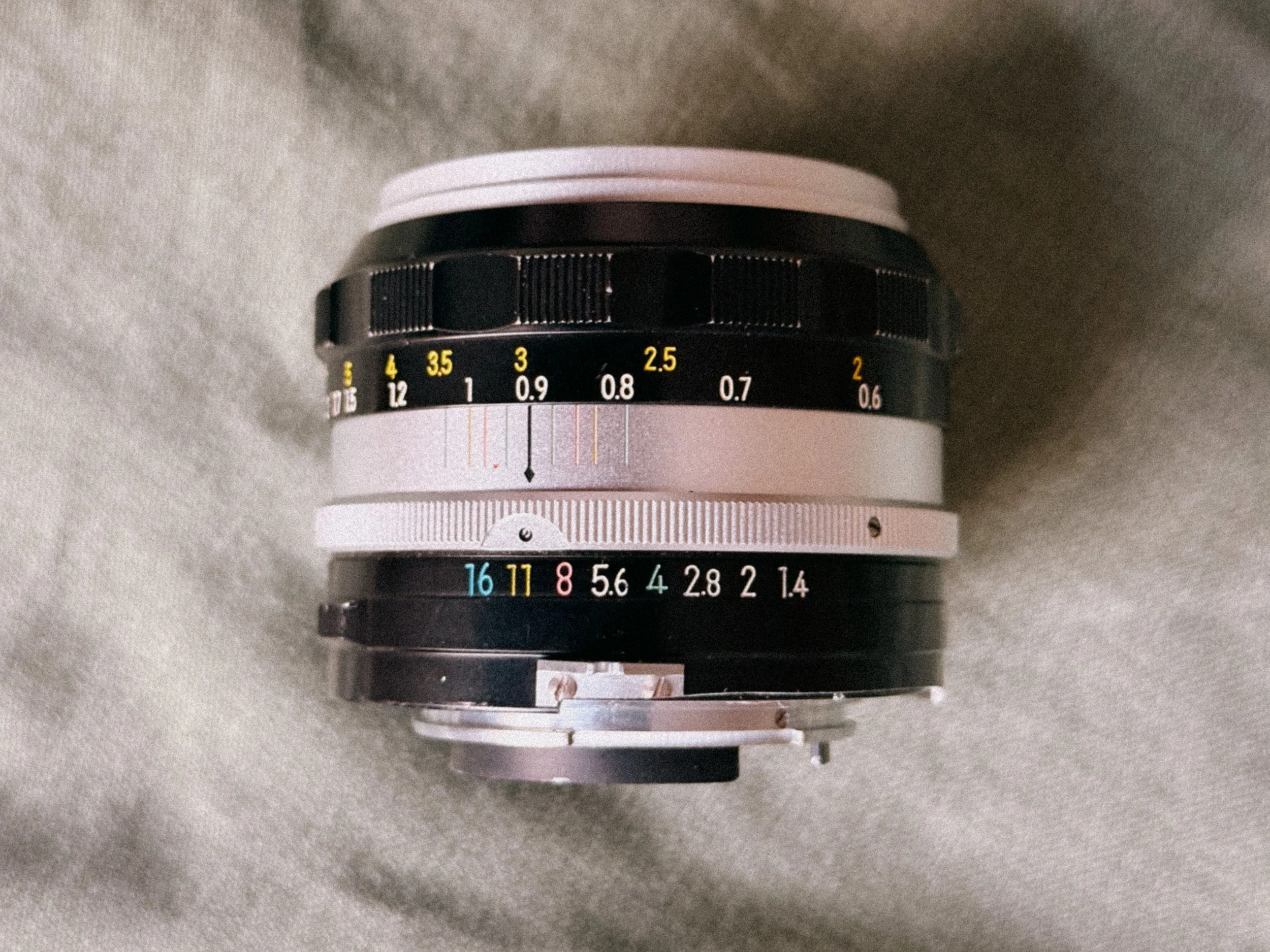
A very rough NonAI to AI Conversion
Because it doesn't have that delicate internal prong, you can tap into the largest pool of vintage lenses ever made. And trust me, there are some great ones beneath them! You are free to use Nikkor Non-AI, AI, AIS and Series E lenses without ever having to worry about bending or snapping a coupling pin. While mounting an unmodified "Pre-AI" lens on a modern Nikon DSLR or a late-model F2 can result in an expensive repair bill, the original Nikon F handles these early lenses with ease.
This means you can hunt for the most affordable, heavy-metal vintage glass from the early '60s and mount it with total confidence. Whether you are looking for the legendary single-coated "S-Line" lenses or the later, high-contrast AIS glass, the Nikon F is the ultimate "universal" body. It allows you to experiment with 60 years of optical history on a single mount, making it the most versatile entry point into high-end analog photography.
Let me rephrase, cause this is important:
On the Nikon F, you can build a whole lineup of glass that is on par with Leica or Leitz lens quality, but for the price of a single Leica lens, you can easily get four to five legendary Nikkors.
Shooting the Nikon today: Ergonomics and Quirks
Let’s be honest: If you are looking for a camera that melts into your hand, the Nikon F is not for you. It’s not uncomfortable at all, some things just take some “getting used to”.
The Shutter Button "Problem"
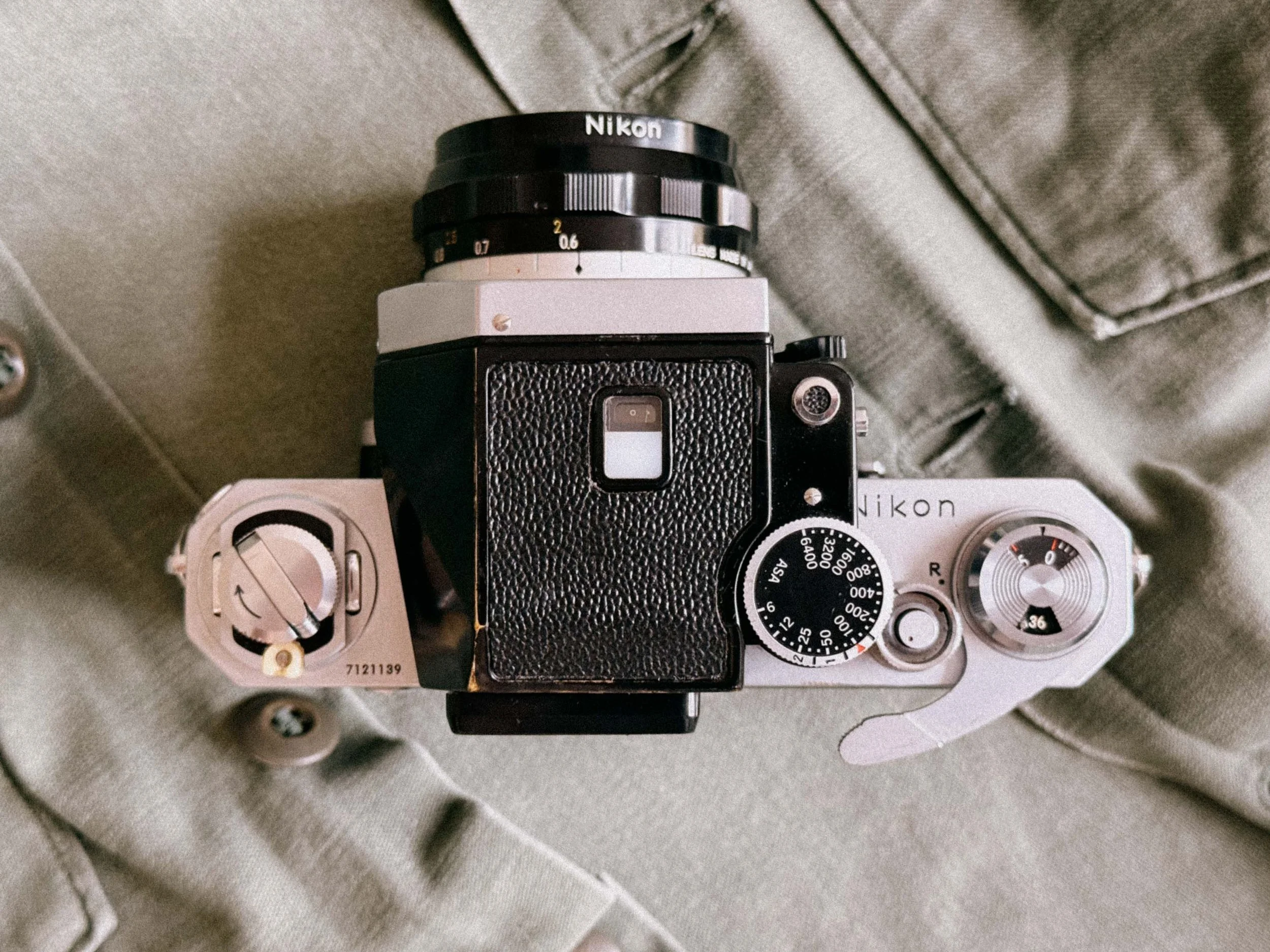
The “offset” shutter button
The first thing you’ll notice is the shutter button. Unlike the later Nikon F2 or the FM series, the button on the original F is located further back on the top plate. For many, this feels unnatural at first.
Tip: Many photographers use a Nikon AR-1 soft release or a similar third-party button. It raises the profile of the shutter release and makes it easier to find.
The Muscle Memory Trap: Focus Direction
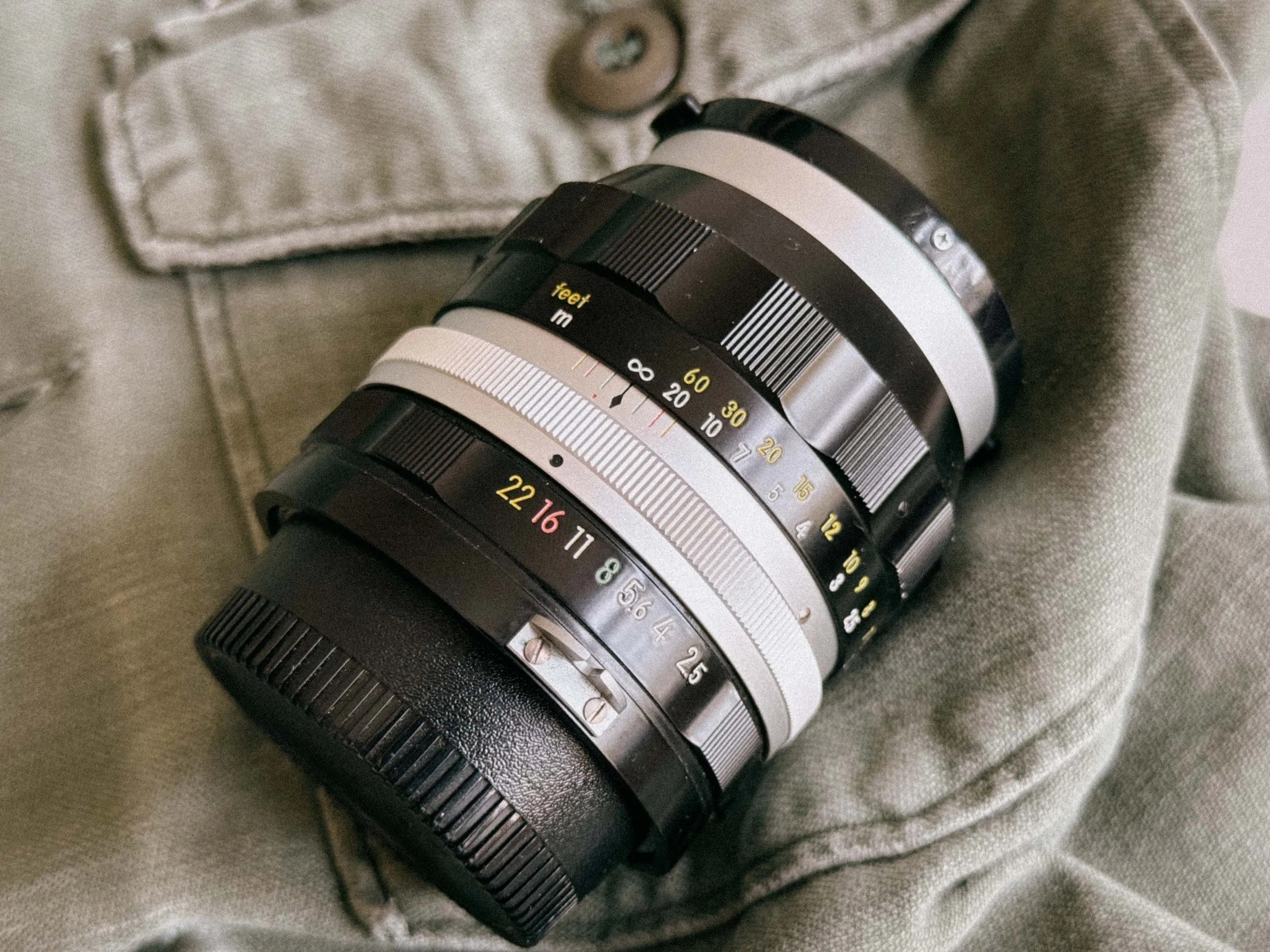
Yes infinity is on the other side on Nikkors.
If you are coming from any other systems, be prepared for a bit of a brain-freeze: Nikkor lenses focus the "other way around." To reach infinity, you turn the ring counter-clockwise. This can lead to some frustrating "missed focus" moments at first, but it does not take long before it becomes second nature.
The 1kg Workout

It was not designed to be lightweight.
Is it heavy? Yes. With a Photomic finder and a 50mm f/1.4 lens, you are carrying over one kilogram of solid brass and glass. But there is a benefit: the weight makes the camera incredibly stable for handheld shots at slow shutter speeds like 1/15th or 1/8th of a second. It acts like a built-in mechanical stabilizer.
The Film Loading
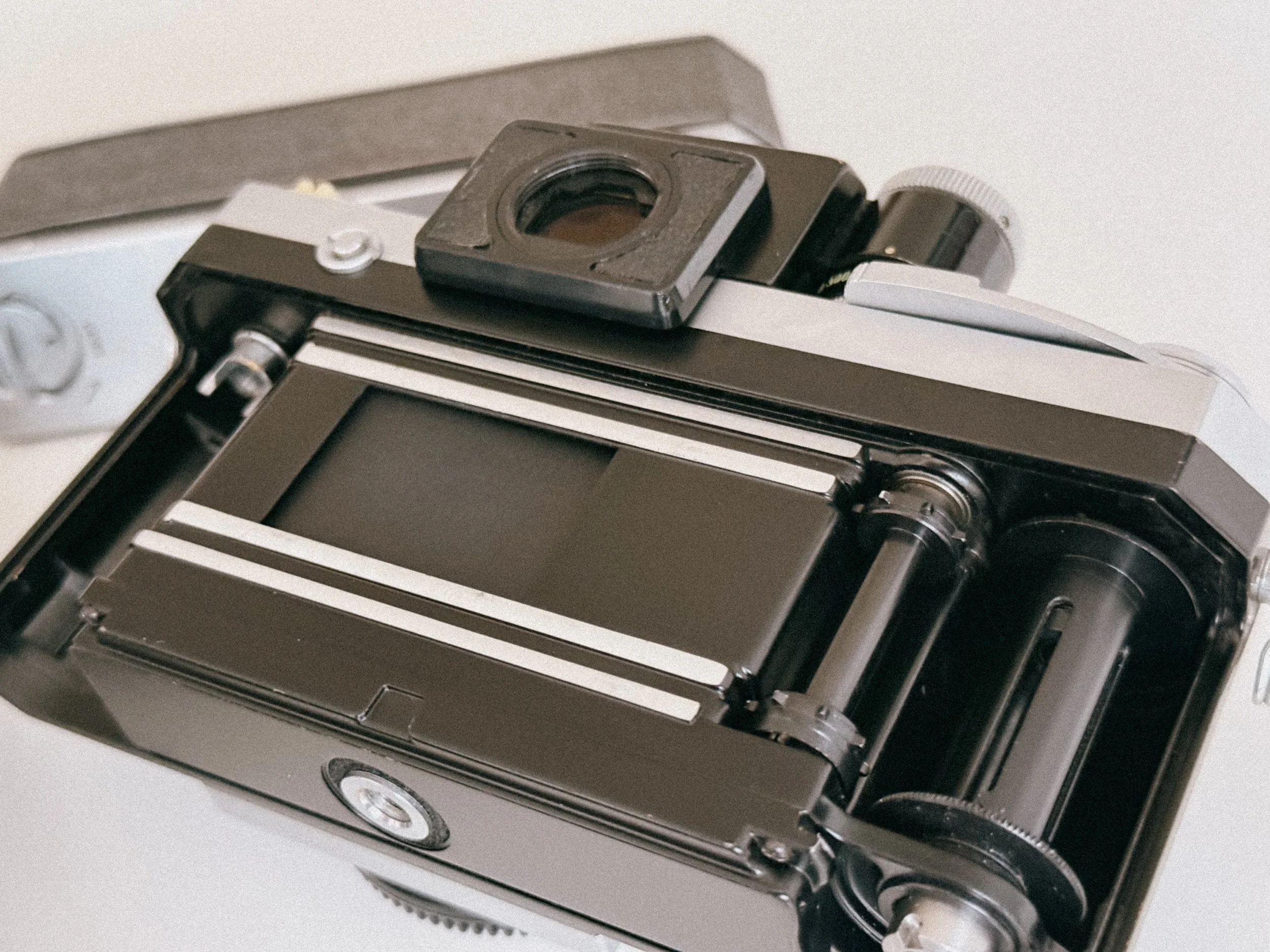
Film Spool and Shutter of the Nikon F
The removable back is the Nikon F's most famous quirk. But to be honest, it’s not half as bad as many people claim it to be. However, this design hides a massive technical advantage: The Nikon F does not require foam light seals. While almost every other vintage SLR relies on adhesive foam strips that eventually rot, turn into a sticky mess, and cause light leaks, the Nikon F uses a precision-engineered metal-to-metal light trap. Much like the legendary Canon P rangefinder (full review here), the Nikon F is built to be light-tight. It’s one less thing to worry about and a huge win for long-term durability.
The "Wobbly" Advance Lever
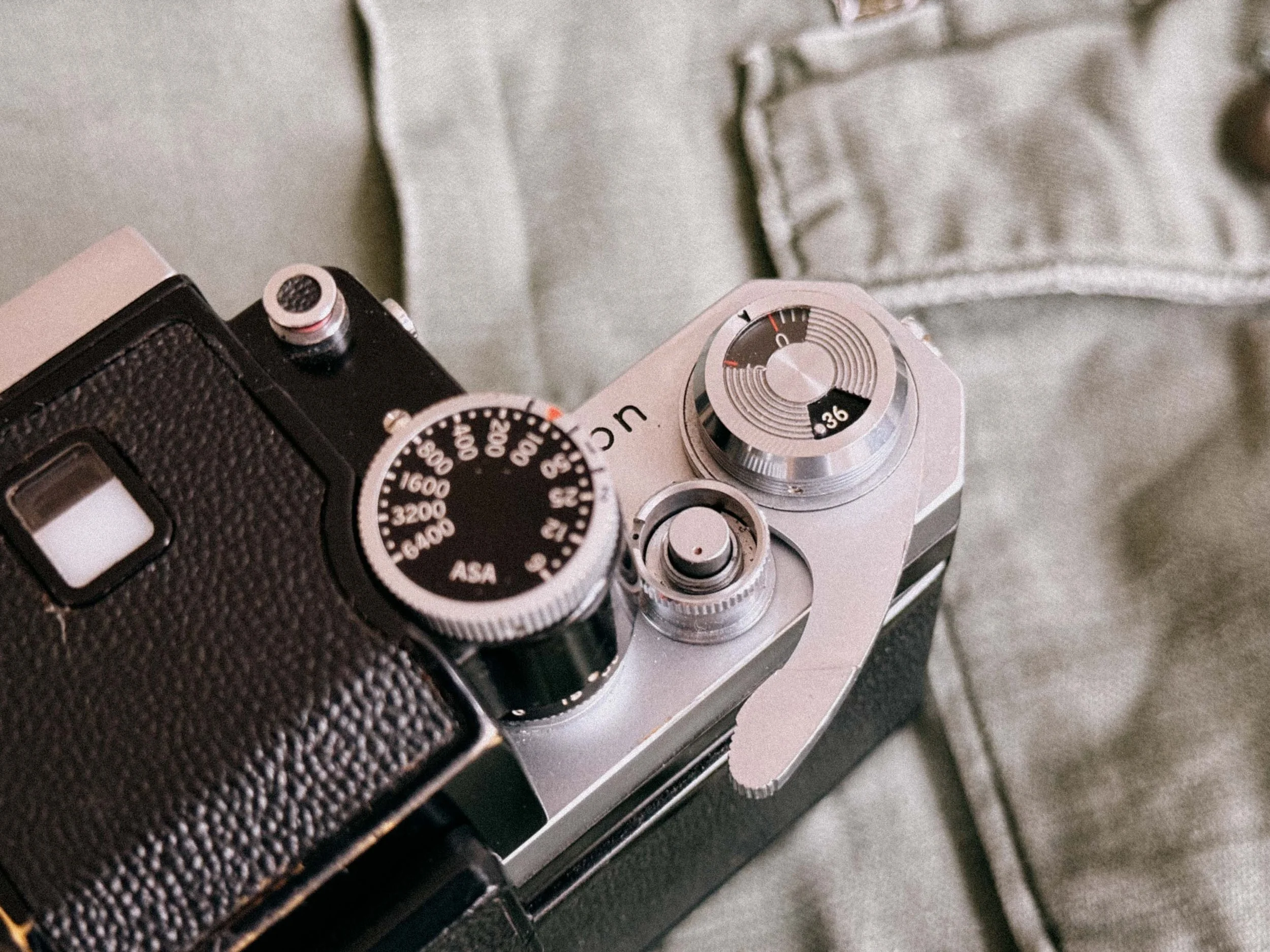
Don’t worry the lever is designed to have some play
When you pull the film advance lever out to its "ready" position, you’ll notice it has a bit of play or "wiggle" before it actually starts to tension the shutter.
Don't Panic: This isn't a sign of a loose screw or a worn-out spring. It is a deliberate design choice. This "stand-off" position allows you to hook your thumb behind the lever for rapid-fire shooting, and the slight play ensures that you don't accidentally put tension on the internal gears while just walking around with your thumb on the lever. It can feel slightly wobbly because of its folding design, built-in mechanical tolerances.This small amount of play is normal and helps ensure reliability, especially in tough conditions. However, if the lever feels very loose or doesn’t advance smoothly, it may need servicing.
Flash and Accessories
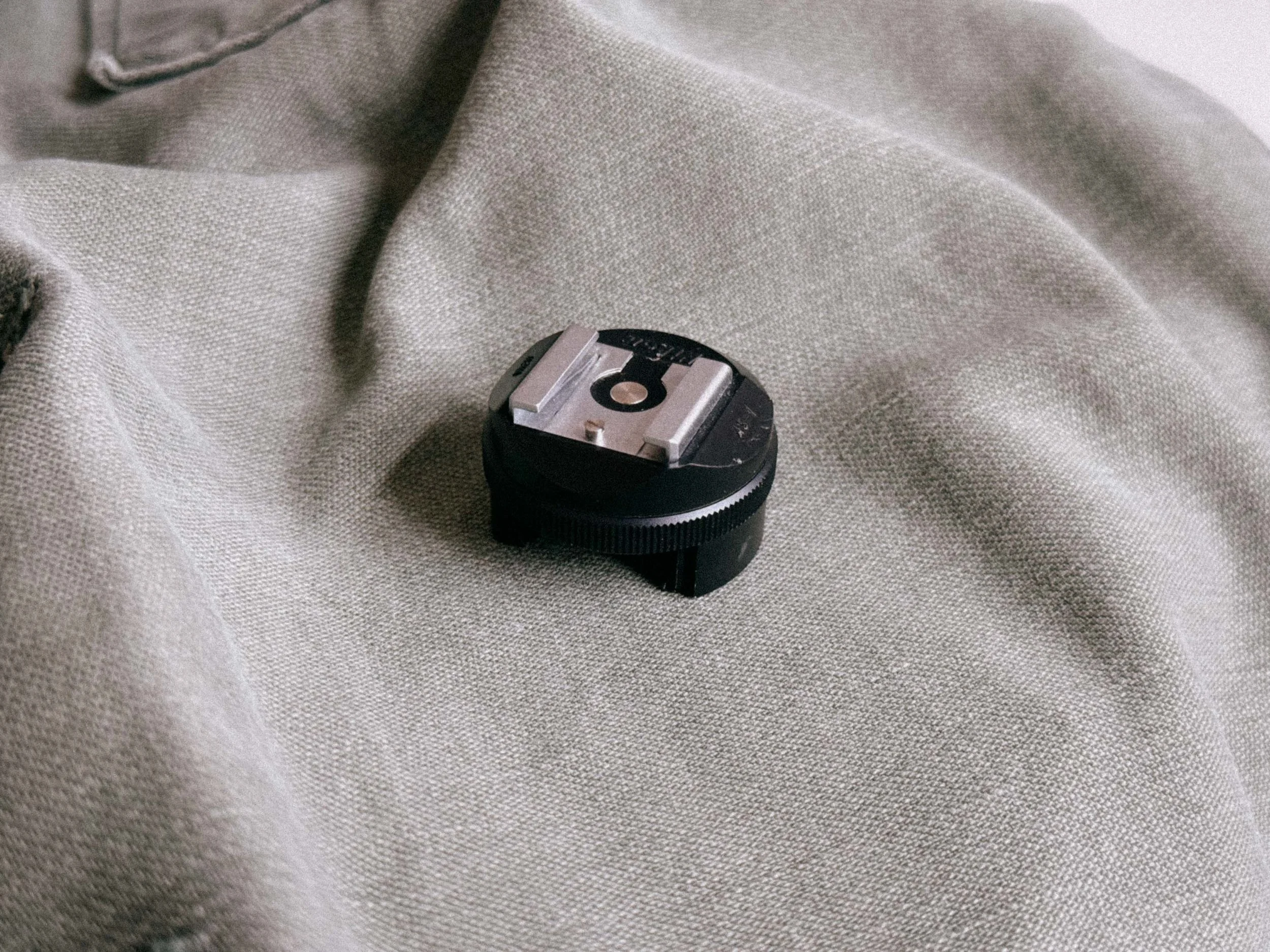
The Nikon AS-1 Adapter
The Nikon F does not have a standard ISO hot shoe. It uses a unique mount around the rewind crank. If you want to use a modern flash or a wireless trigger in 2026, you’ll need the Nikon AS-1 adapter. Without it, your flash setup stays dark.
If you are new to the whole “flash on film” topic. I wrote a complete guide on how to get started. This topic seems somewhat over mystified. And it should not be! Read here.
The "Nikon Shuffle"
If you are using a Photomic FTN finder, remember the "Nikon Shuffle." Every time you change a lens, you have to twist the aperture ring all the way to the left and then all the way to the right to "index" the lens.
The Shutter Release Cable (The AR-2)
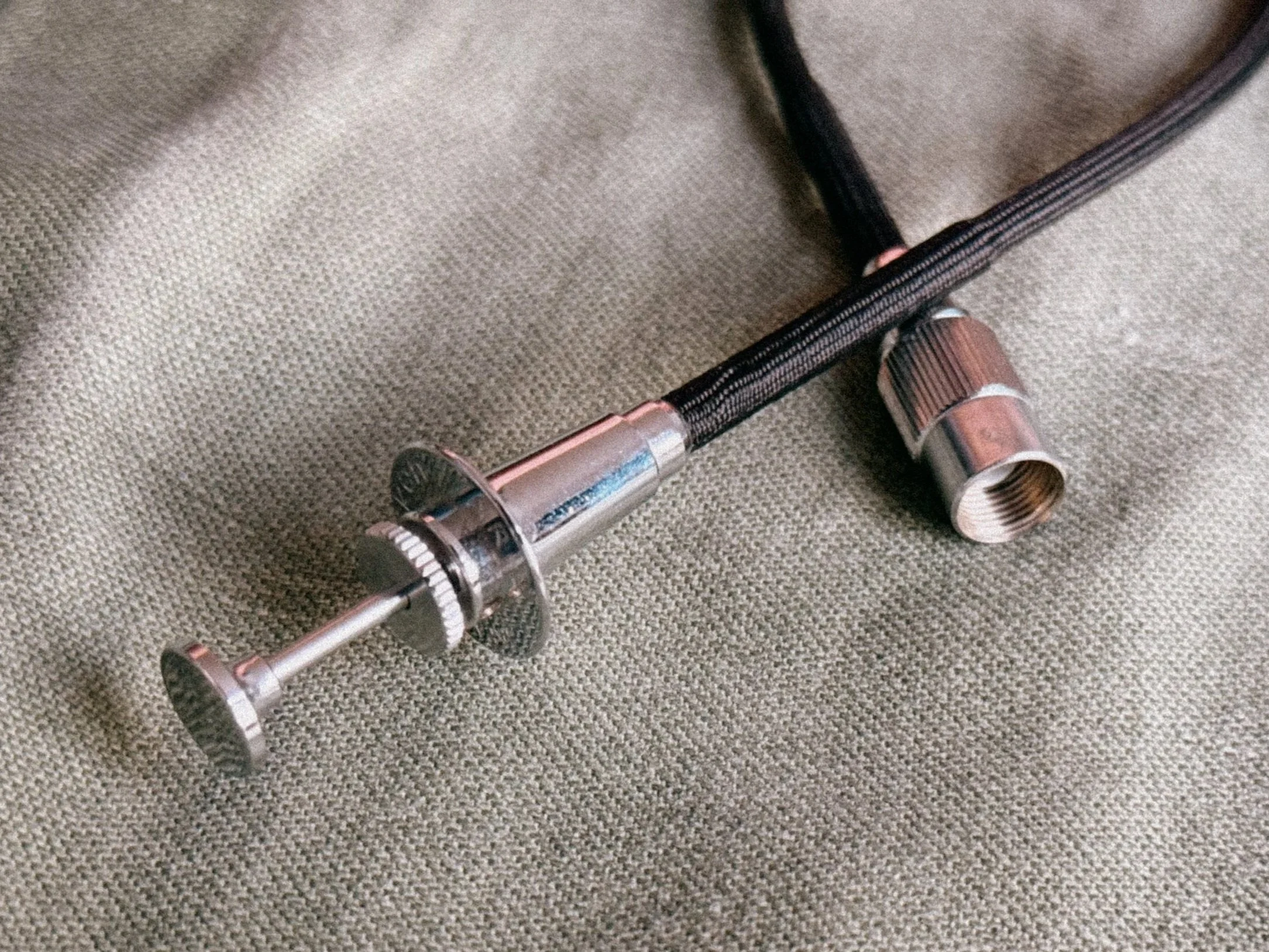
The sturdy AR-2 - Also works with the F2 body!
The Nikon F uses a proprietary "Leica-style" bell mount. To use a remote trigger for long exposures or tripod work, you need the Nikon AR-2 cable release (or a "Nikon to Standard" adapter). It’s a small detail, but realizing your standard cable release will not fit during a shooting is something you want to avoid.
The Ultimate Pre-AI Lens Kit for the Nikon F
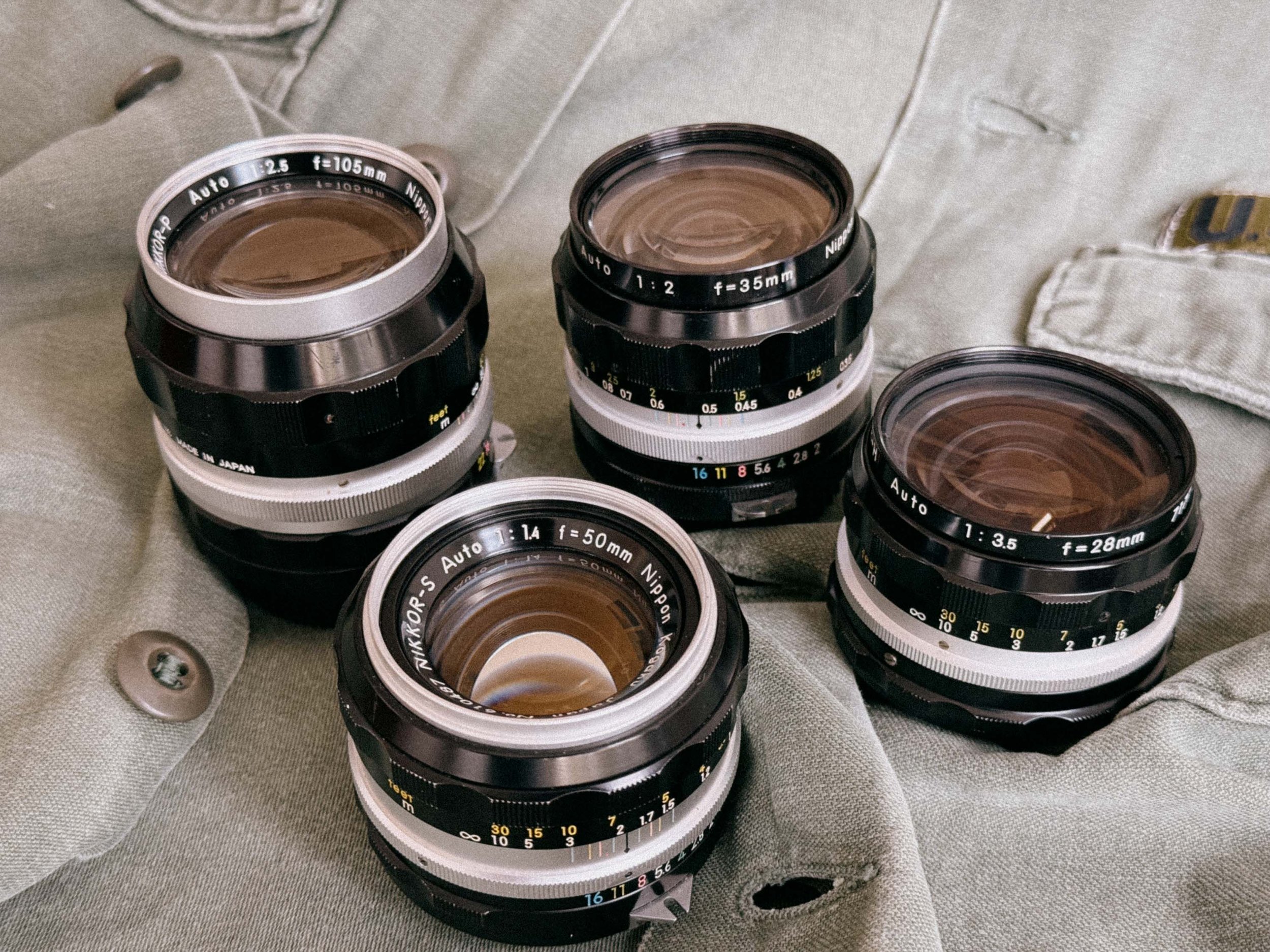
My ultimate Lense kit
If you want to experience the Nikon F without breaking the bank, you don't need twenty lenses. You need a curated kit that covers everything from street photography to intimate portraits.
I can’t stress enough how well-built these vintage Nikkor lenses are. We are talking about brass, precision-ground glass, and a mechanical feel that makes modern plastic lenses feel like toys. But it’s not just about the build. These lenses have a specific "rendering" – a look that combines vintage character with surprising resolution. You should be able to tell that i am a fan by now.
Anyway, here is my recommended lineup.
1. The Wide-Angle: Nikkor-H 28mm f/3.5
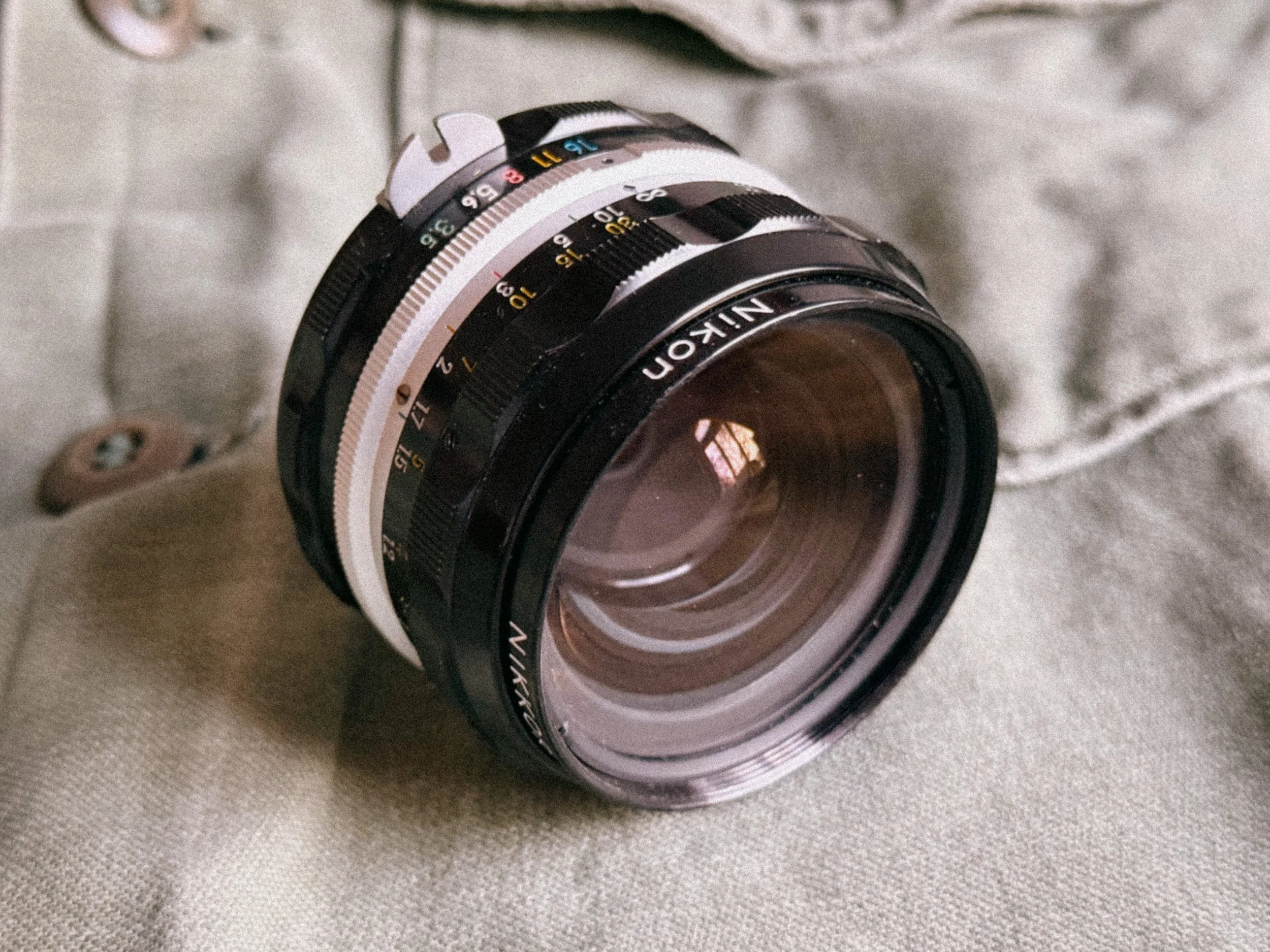
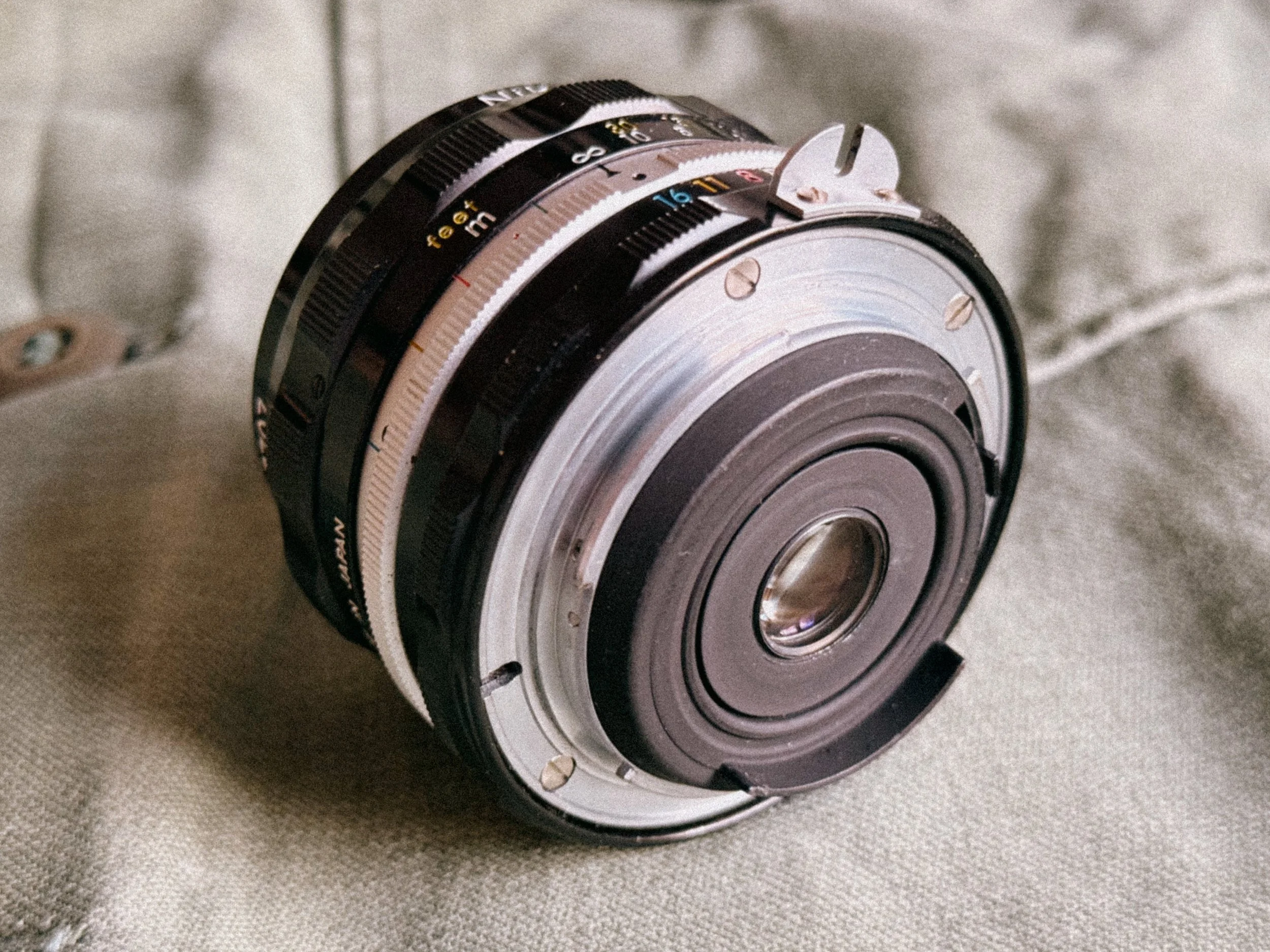
Don’t let the f/3.5 aperture fool you. This lens is legendary for its edge-to-edge sharpness and almost zero distortion. It is incredibly compact, making it the perfect companion for the heavy Nikon F body. In 2026, these are often found for under $100, which is an absolute steal for a piece of glass that feels this mechanical and precise. It’s just not the best for dark scenes though.
2. The Classic: Nikkor-O 35mm f/2
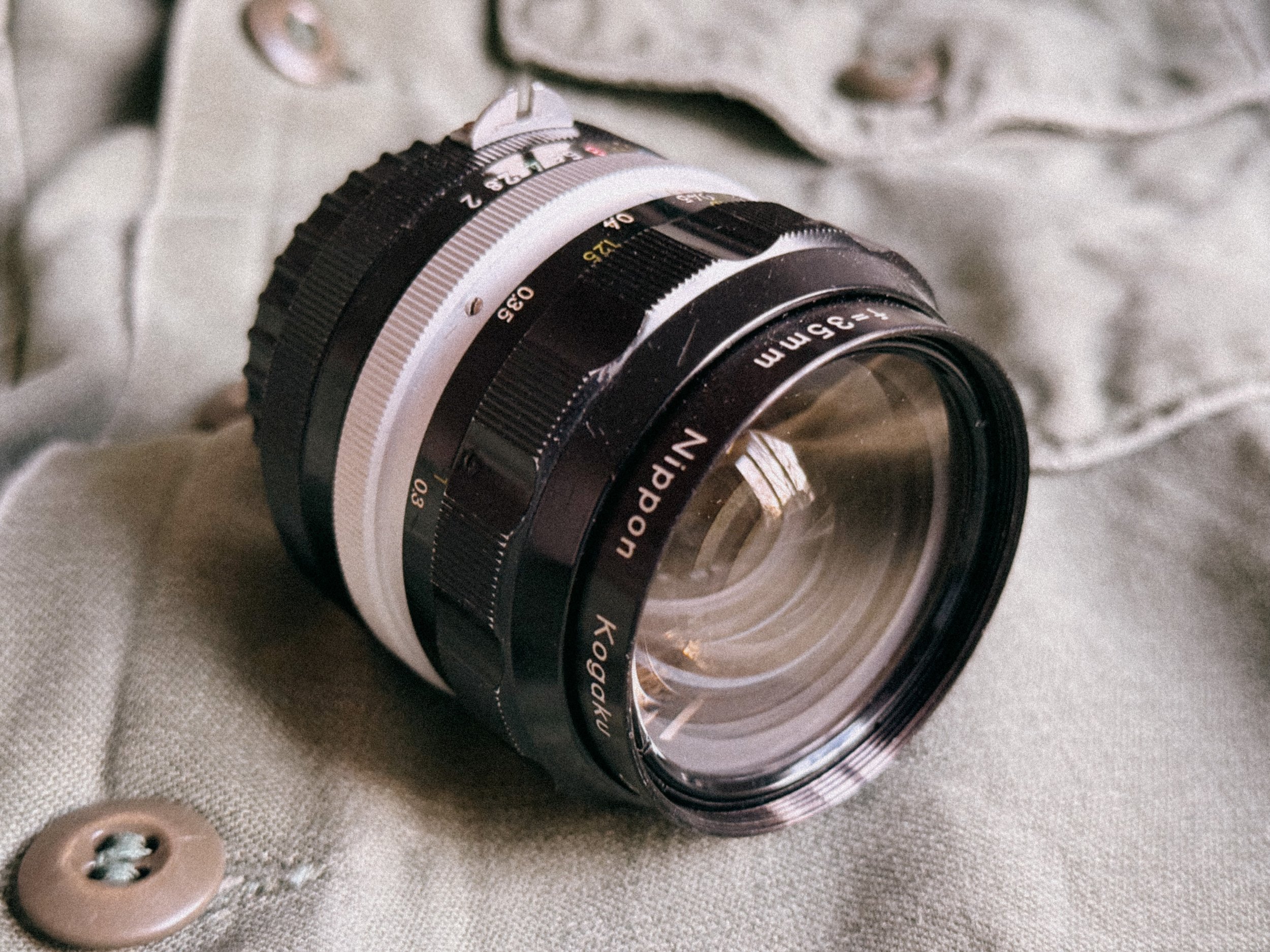
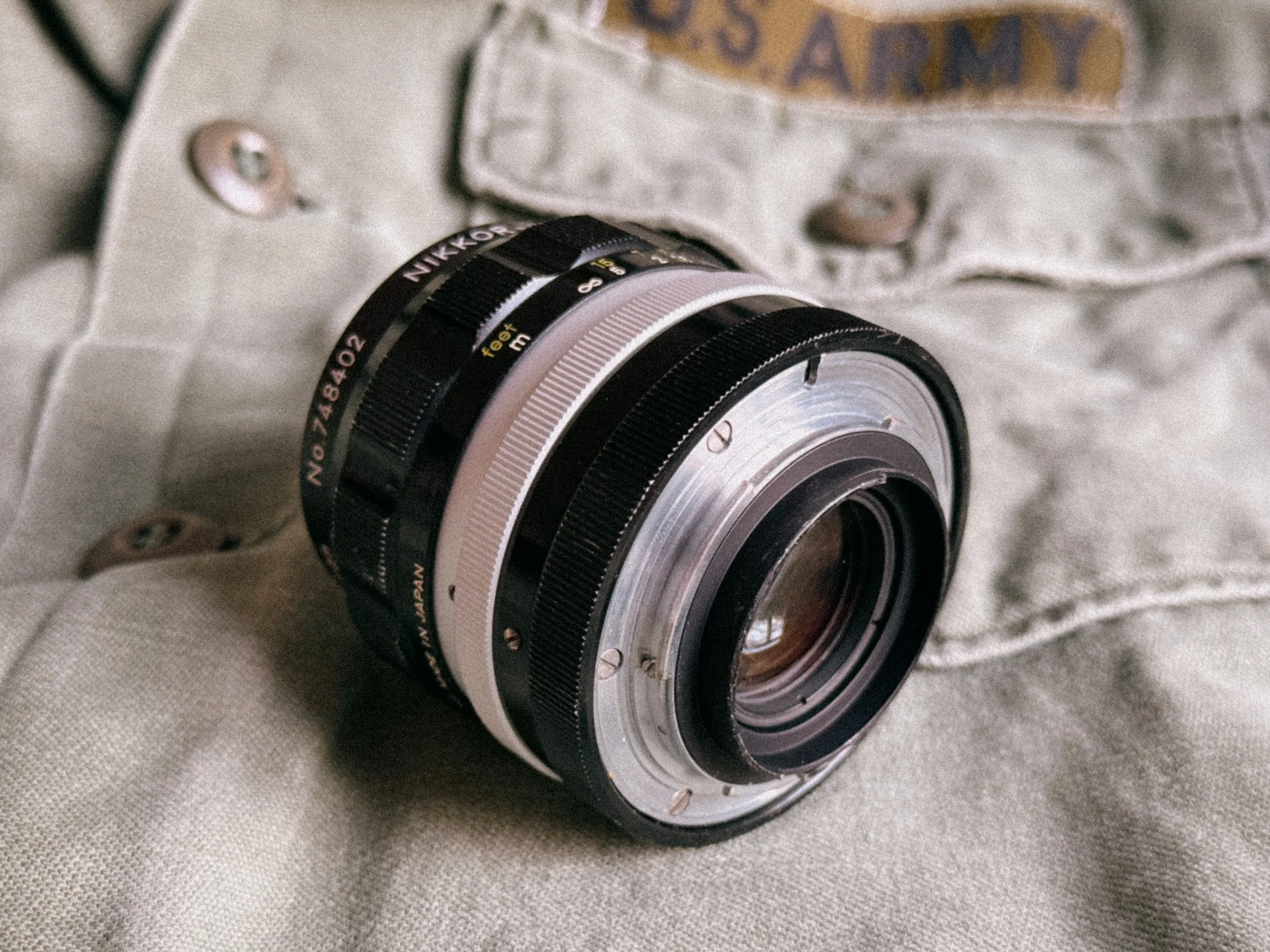
If you could only have one lens on your Nikon F, this should be it. The 35mm f/2 is fast enough for low-light situations and has a beautiful, slightly "glowy" character wide open that sharpens up significantly by f/4. It’s the quintessential documentary lens of the 60s, the lens that captured history.
3. The Standard: Nikkor-S 50mm f/1.4
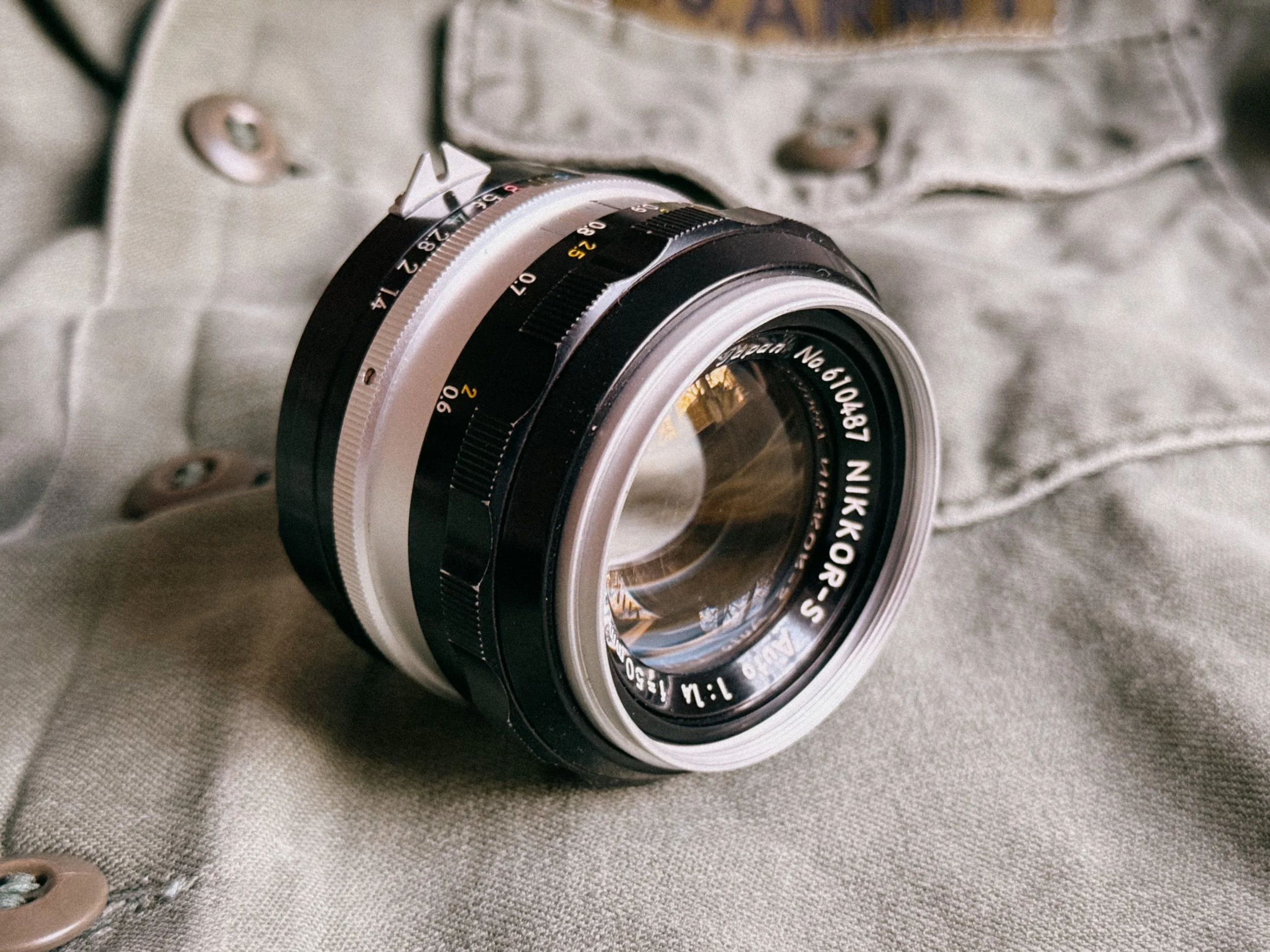
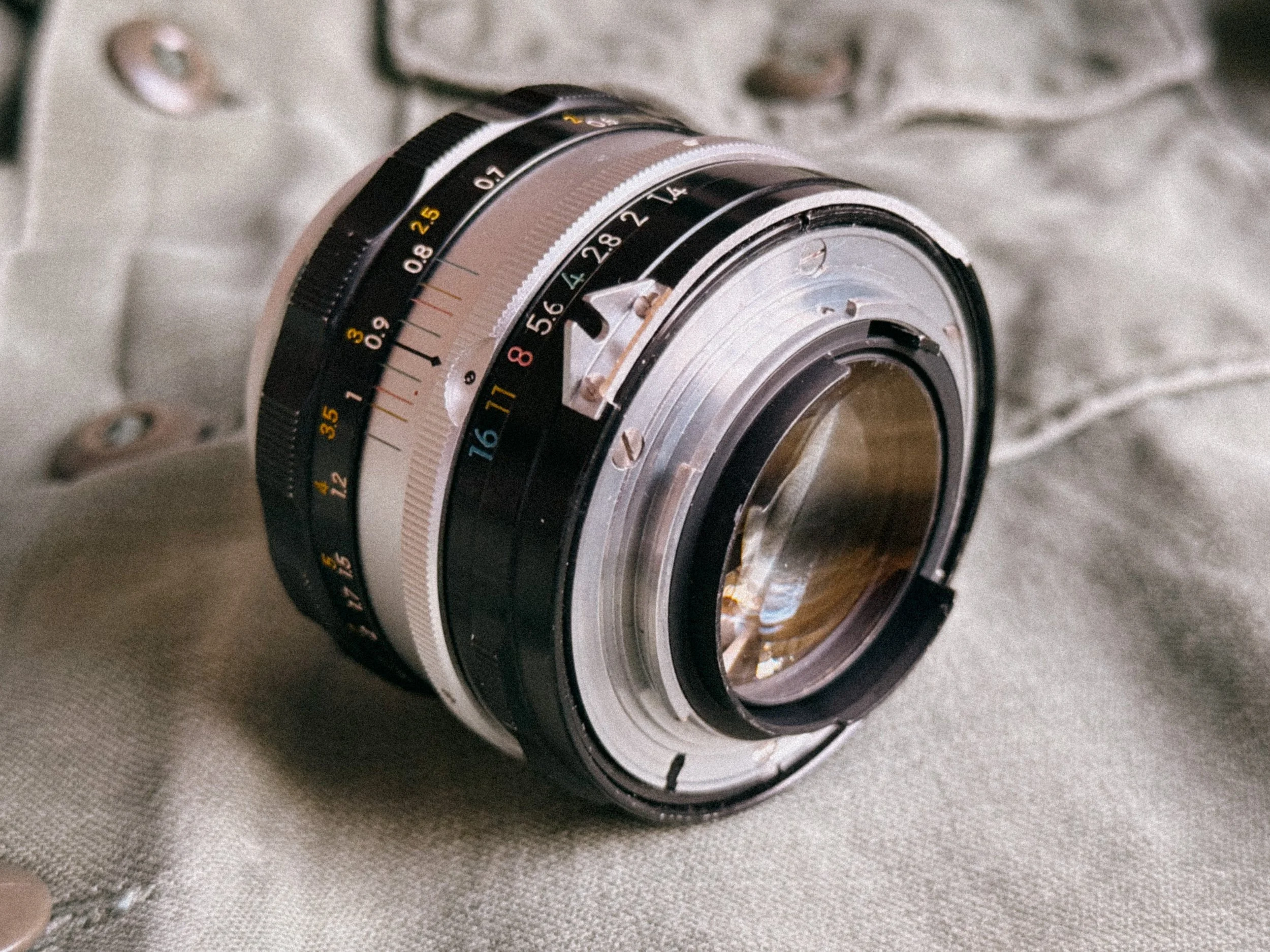
This is the "Standard" lens that defined the Nikon F era. The "S" stands for Septem (seven elements), and this glass is pure character. While it's slightly soft and dreamy wide open, perfect for moody, atmospheric shots, it becomes very-sharp as soon as you stop it down. It’s a heavy, brass-heavy masterpiece that balances perfectly on the Nikon F body. If you want that classic 1960s photojournalist look, this is your lens.
4. The Legend: Nikkor-P 105mm f/2.5
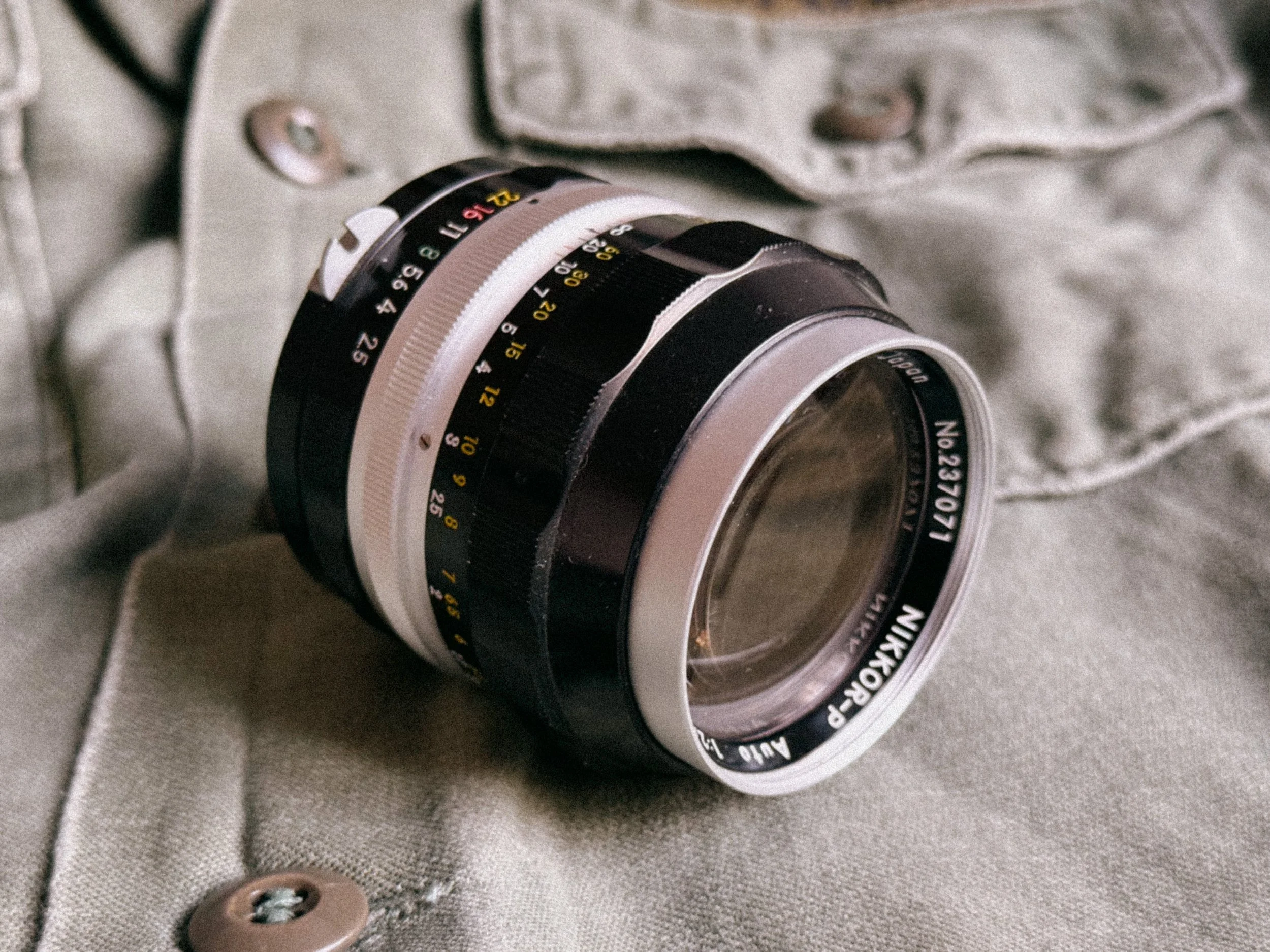
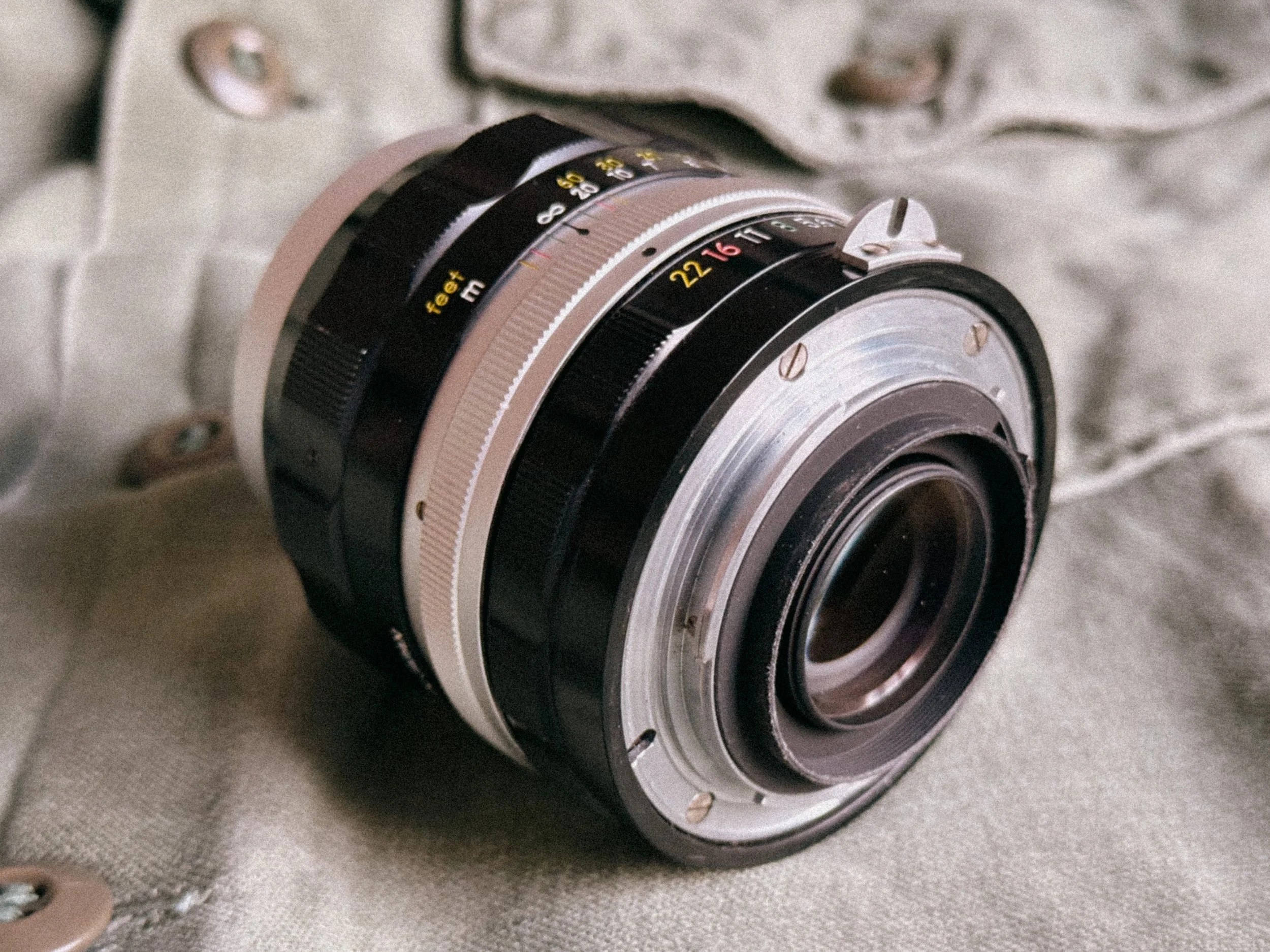
This is arguably one of the greatest portrait lenses ever made by any manufacturer. It has the rare ability to render portraits that look soft and sharp at the same time, I don’t know exactly what or how they did it, but this glass is truly exceptional. Before the later "Gauss" design, this early Pre-AI version used a Sonnar design that produces a dreamlike, creamy bokeh that other lenses simply cannot replicate. If you want that iconic "Afghan Girl" look, this lens is mandatory.
The Nikkor Alphabet
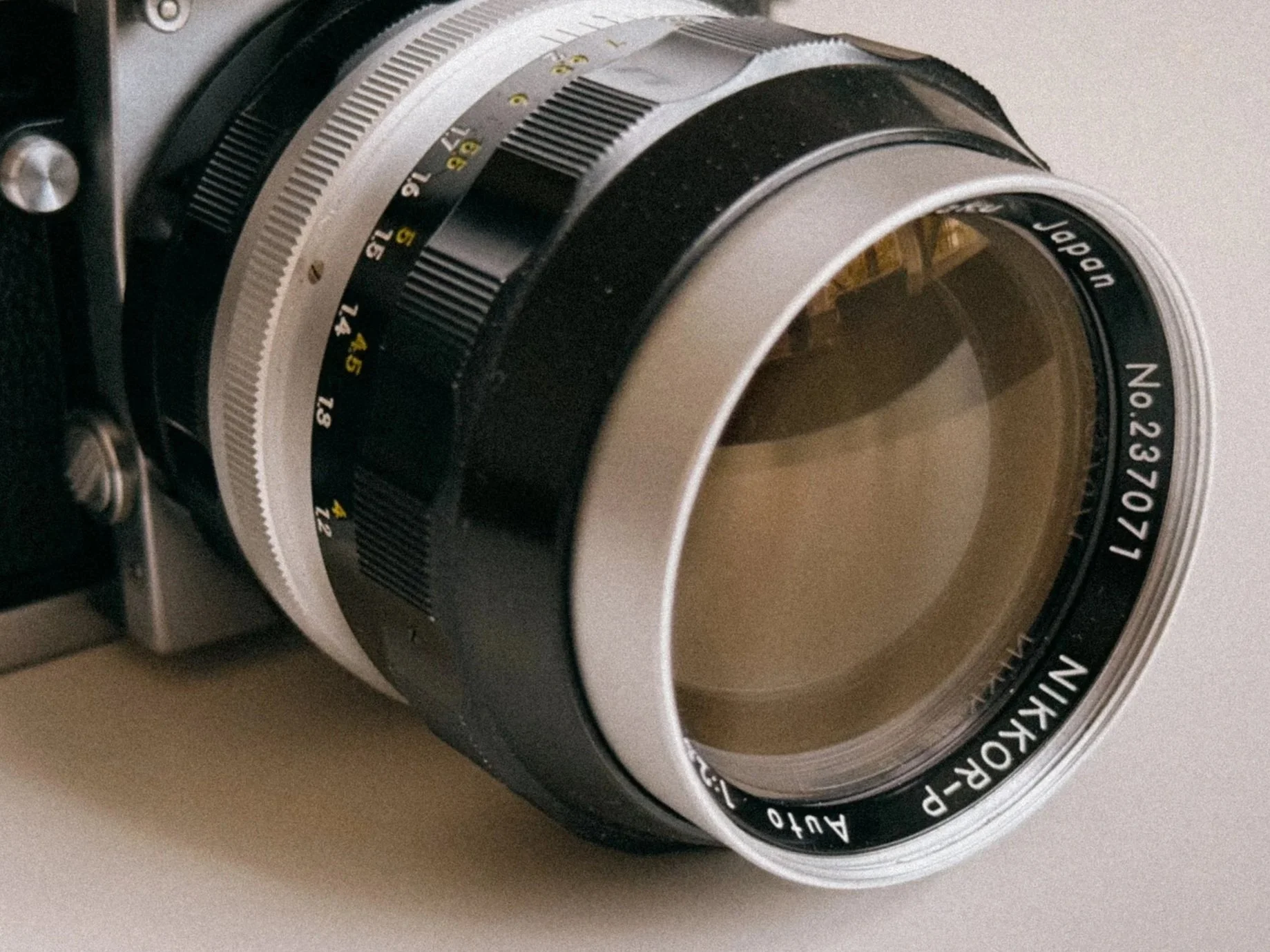
Nikkor-P Close up showing part of the Nikkor Naming Philosophy
When you look at a vintage Pre-AI lens, you’ll notice a letter right after the "Nikkor" name (e.g., Nikkor-S). This isn’t just branding; it tells you exactly how many glass elements are inside the lens. Nikon used a system based on Latin and Greek prefixes for numbers.
Knowing this helps you understand the complexity, and often the rendering character, of the lens you are holding.
| Letter | Origin (Latin/Greek) | Elements | Example |
|---|---|---|---|
| U | Unus | 1 | Ultra-rare optics |
| B | Bini | 2 | Early tele-converters |
| T | Tres | 3 | Nikkor-T 10.5cm f/4 |
| Q | Quatuor | 4 | Nikkor-Q 135mm f/3.5 |
| P | Pente | 5 | Nikkor-P 105mm f/2.5 |
| H | Hex | 6 | Nikkor-H 28mm f/3.5 |
| S | Septem | 7 | Nikkor-S 50mm f/1.4 |
| O | Octo | 8 | Nikkor-O 35mm f/2 |
| N | Novem | 9 | Nikkor-N 24mm f/2.8 |
| D | Decem | 10 | Nikkor-D 15mm f/5.6 |
The "C"
Later Pre-AI lenses often have a "·C" after the letter (e.g., Nikkor-S·C). The "C" stands for Coating (specifically Multicoating).
Non-C lenses: Single-coated. They produce more flare and have a "lower contrast" vintage look, perfect for artistic, dreamy shots.
C lenses: Multicoated. They handle backlight much better, have higher contrast, and richer colors.
What does "Auto" mean on Vintage Nikkors?
Don’t get it confused: "Auto" on these lenses has nothing to do with Autofocus.
Back in the day, it stood for Automatic Diaphragm. Before this tech, the more you closed your aperture, the darker your viewfinder became. Trying to focus at f/11 was like looking through sunglasses at midnight.
The "Auto" feature changed the game: it keeps the lens wide open for a bright, clear focus and only "snaps" down to your chosen aperture the millisecond you hit the shutter. It’s the mechanical soul of the Nikon F system.
Nikon F Buying Guide & Service: Keeping it Alive
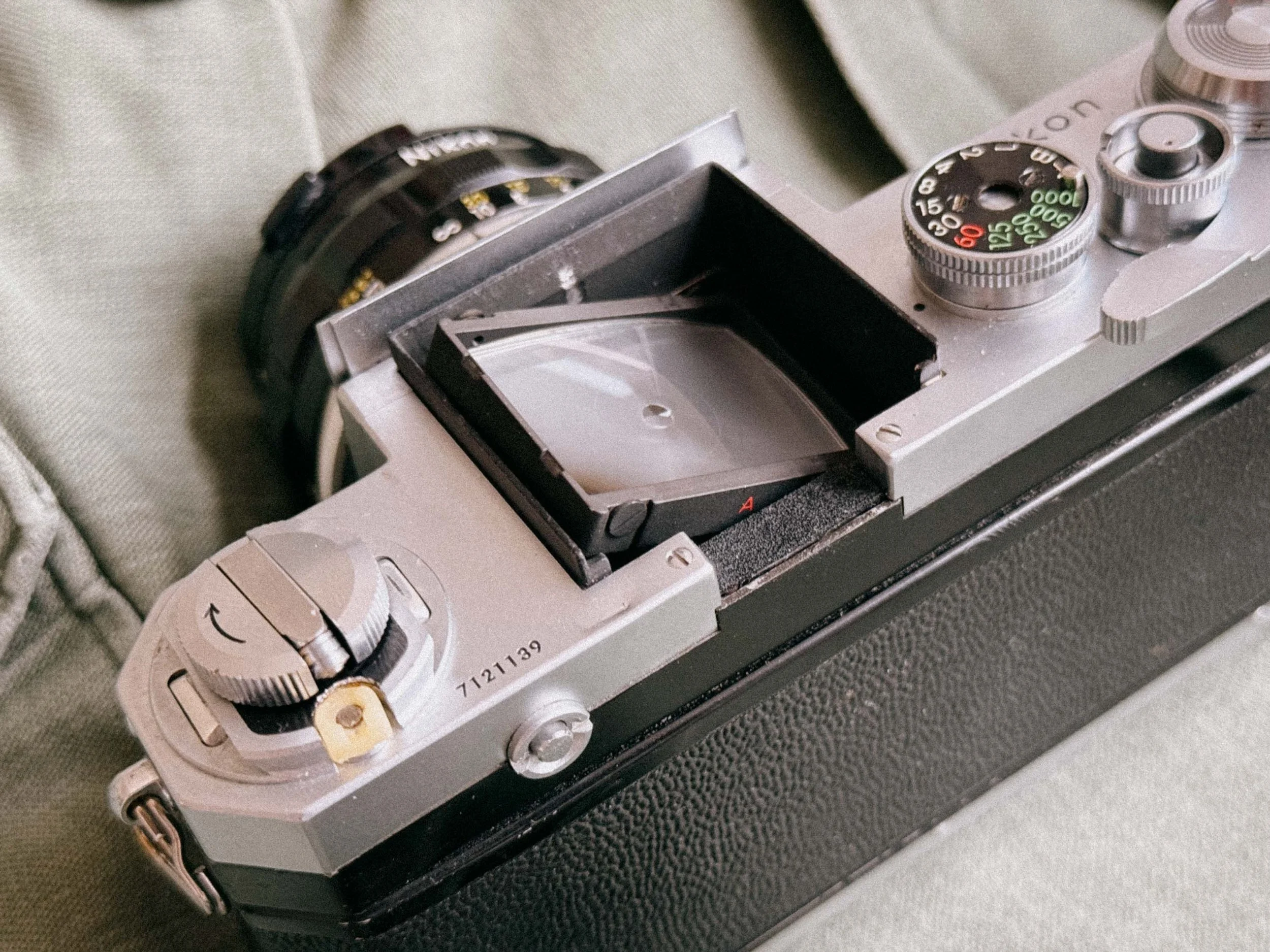
A little cleaning goes a long way!
In 2026, buying a Nikon F is a bit of a gamble if you don't know what to look for. These cameras are around sixty years old; they’ve seen things. To ensure your "new" camera doesn't end up as a very heavy desk ornament, here is an inspection list.
1. The Viewfinder: Desilvering & "The Gutter"
Look through the finder. Do you see a dark horizontal line or "clouds" at the bottom? That’s desilvering (prism rot).
The Inspection: Look for dark horizontal lines, "black snow," or cloudy patches at the bottom of the viewfinder. Be warned that these prisms frequently suffer from de-silvering, a permanent darkening or "clouding" of the optical glass. This is caused by the original internal foam seals deteriorating over 60 years and chemically attacking the silver coating. It’s essentially irreparable and the main reason why clean "Eye-Level" prisms now cost more than the camera bodies themselves.
If you find a clean one, service it immediately. Whether you DIY or send it to a professional like Hoffmann, the old foam must be removed and replaced with modern, stable materials. If you leave the original foam inside, it’s not a matter of if the prism will rot, but when.
2. The Focusing Screen Condition
The Nikon F has interchangeable screens, which is great, but they are often scratched from decades of improper cleaning.
A scratched Focusing Screen won't affect your final photo, but it will drive you crazy while focusing. Check for cleaning marks or scratches. If it's too bad, the good news is you can swap it out in seconds. Clean ones are still not cheap though.
3. The Titanium Shutter: Look for "Ripples"
Inspect the shutter curtains. The Nikon F uses titanium foil. It’s incredibly tough, but look for:
Wrinkles/Capping: If the curtains look like crumpled foil or don't open fully at 1/1000s, the camera needs a specialist.
Pinholes: Hold the open camera (without a lens) up to a light and look for tiny stars in the shutter. Titanium is better than cloth, but not invincible.
4. Slow Speeds & "The Sticky Mirror"
Fire the camera at 1 second. If it sounds more like 3 seconds, or if the mirror stays up for a moment before clicking back down, the lubricants have turned into glue. This is the #1 sign that a CLA (Clean, Lubricate, Adjust) is overdue.
5. The Photomic Meter: Dead, Jumping, or "Lying"?
In 2026, finding a working meter is tough because the original 1.35V mercury batteries are banned. (See the FAQ below for the best modern battery solutions) Many shooters simply use the Photomic finder for its aesthetics and use a smartphone metering app or a tiny shoe-mounted light meter (like the small Keks meter) for exposure. But if you want the "true" 1960s experience, a calibrated internal meter is unmatched.
6. The "Impact" Check: Dents and Bends
Because the Nikon F is made of thick brass, it takes a lot of force to dent it.
Watch for "Hits": Check the corners of the top plate and the baseplate for deep dents. If a camera has fallen hard enough to dent brass, the internal prism might be cracked, or worse, the lens mount might be slightly bent out of parallel.
Maintenance & CLA: Why It’s Essential
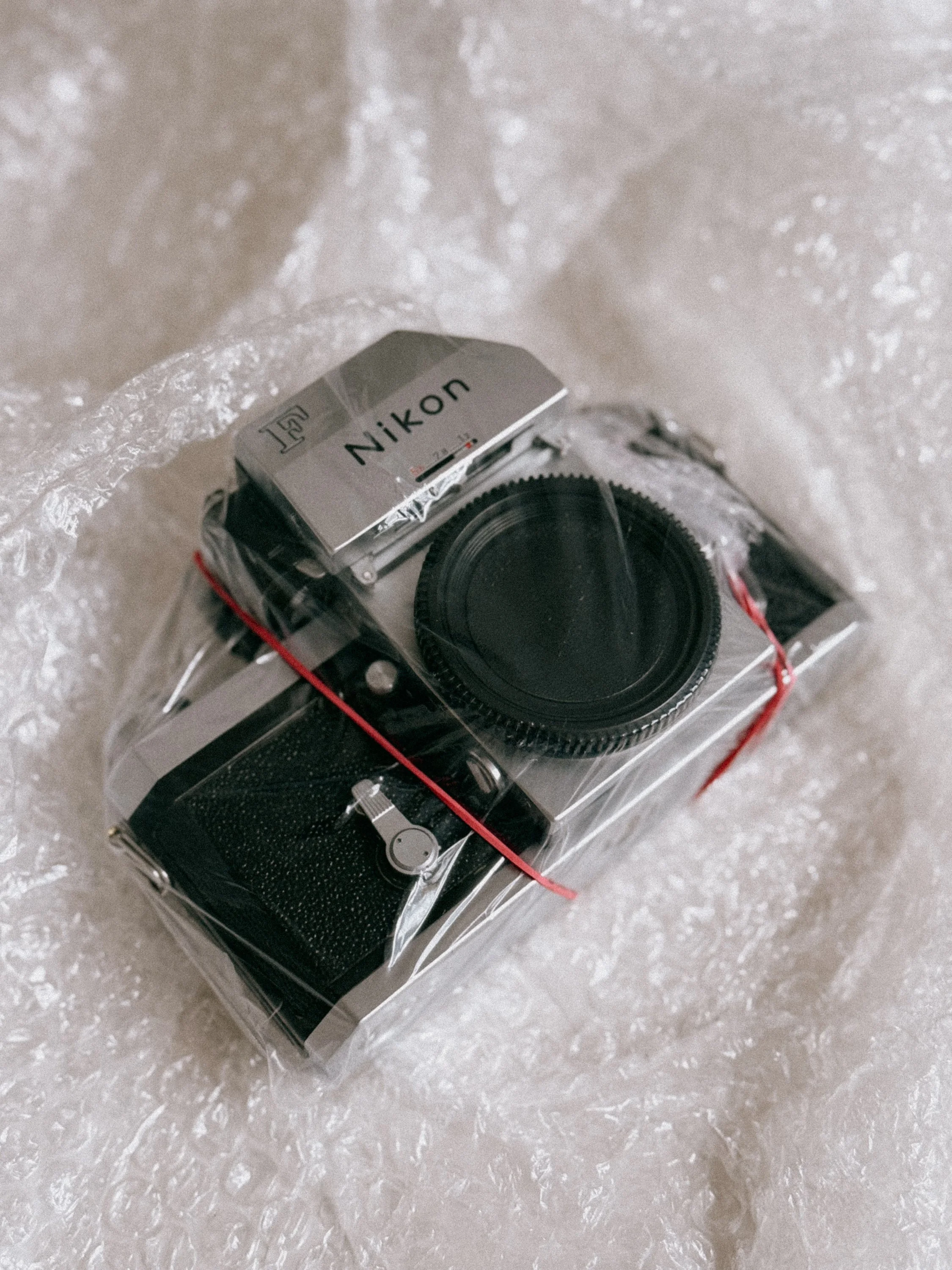
Freshly serviced Nikon F
I can’t stress enough how well-built these vintage Nikkor lenses and bodies are. We are talking about 60-year-old brass and glass that can still operate with the precision of a Swiss watch. But time is an enemy even a Nikon cannot defeat alone.
The Specialist: Foto Kamera Service Hoffmann
If you are in Central Europe, there is one name every Nikon F shooter needs: Foto Kamera Service Hoffmann (Stuttgart). Henry Hoffmann is one of the few left who can properly service these machines.
The Photomic: They can recalibrate your dead Photomic finder from the old 1.35V mercury standard to modern 1.5V batteries.
Optical Rescue: They can deep-clean your 105mm Sonnar or 35mm Nikkor-O to remove "vintage haze" and restore the whole lens. (They had to completely renew the helicoid threads on my 28mm 2.0)
A professional CLA doesn't just "fix" the camera; it changes the experience. The shutter sound changes fand the focus rings regain that buttery, weighted resistance that makes shooting a Nikon F so addictive.
Nikon F Frequently Asked Questions (FAQ)
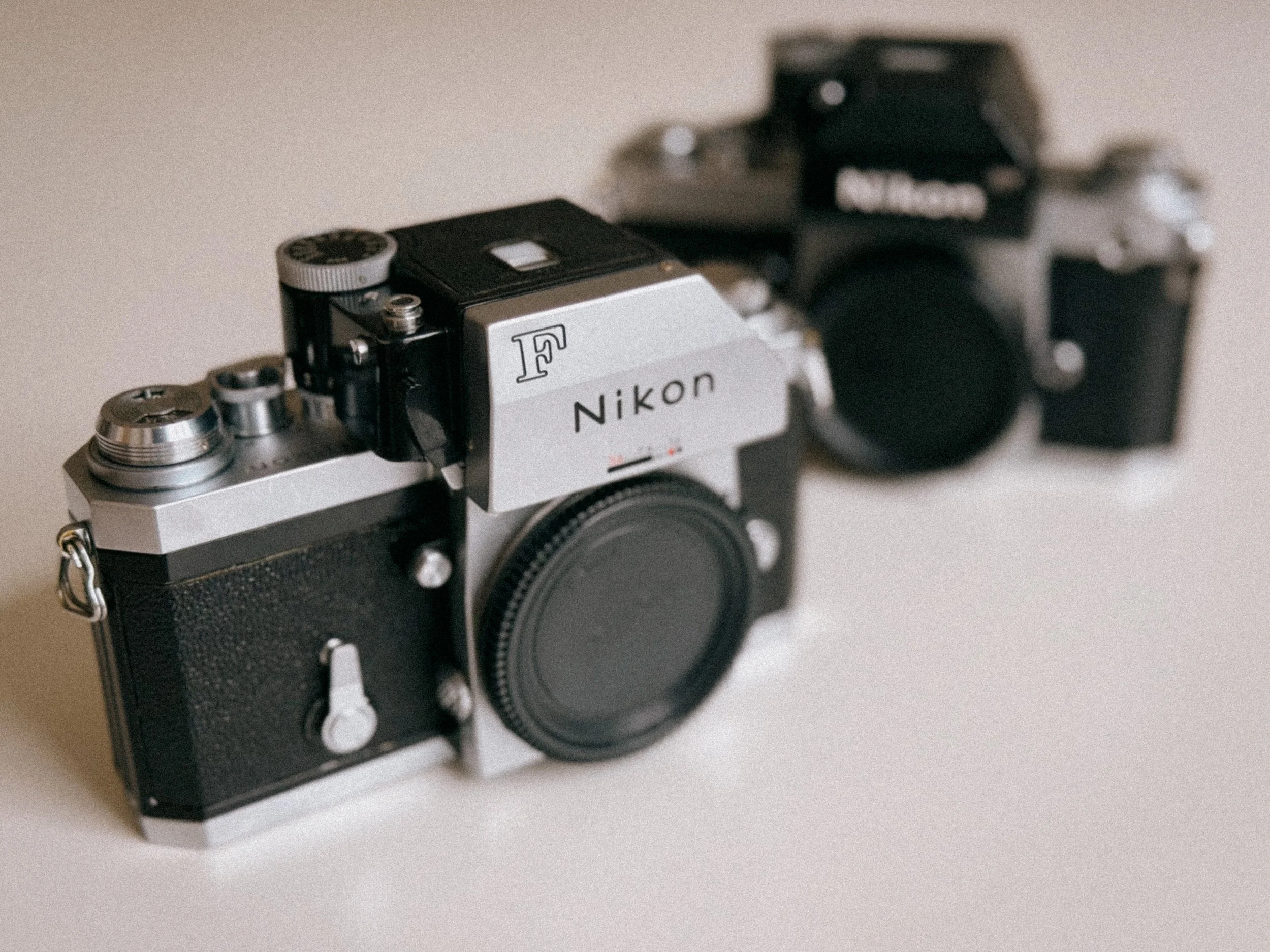
Nikon F or F2 - Which is better? Not an easy question.
1. Can I use modern Nikon lenses on a vintage Nikon F?
The short answer: No, not safely. Most modern Nikon lenses (G-type or E-type) lack an aperture ring, meaning they will only shoot at their smallest aperture (usually f/22). More importantly, never try to force a modern "AF-S" or "G" lens onto a Pre-AI body without checking clearance; you risk damaging the indexing pin of the Photomic finder. Stick to Pre-AI (Non-AI) or AI/AI-s lenses with the "rabbit ears" (coupling prong).
2. How do I power the Nikon F light meter without Mercury batteries?
Since 1.35V mercury batteries are banned, you have three professional options:
The WeinCell MRB625: A zinc-air battery that gives the correct 1.35V but only lasts 3–6 months.
The MR-9 Adapter: A physical adapter with a built-in voltage dropper that lets you use standard 386 silver-oxide batteries.
Professional Recalibration: Have a specialist like Kameraservice Hoffmann recalibrate the internal circuitry to accept modern 1.55V silver-oxide batteries permanently.
3. What is the difference between a Nikon F "Apollo" and a standard model?
The "Apollo" is the nickname for the very last production run of the Nikon F (early 70s). It features plastic-tipped self-timer and advance levers (similar to the Nikon F2). These are highly sought after in 2026 because they are generally "younger" and often in better mechanical condition than early 60s models.
4. Is the Nikon F shutter made of titanium?
Yes. Unlike many contemporaries that used silk or cloth, the Nikon F uses titanium foil shutter curtains. This makes them incredibly durable and resistant. If your curtains look slightly "crinkled," don't panic, as long as the speeds are accurate, a few ripples are normal for 60-year-old titanium.
5. Why is the "Eye-Level" prism more expensive than the metered Photomic finder?
It’s pure supply and demand. The plain Eye-Level prism gives the Nikon F its iconic, triangular silhouette. They are rarer, they don't have electronic parts that fail, and they are much lighter. In 2026, a mint-condition plain prism can cost as much as a full camera body with a Photomic finder.
6. My Nikon F shutter sounds "metallic" or "clunky." Is it broken?
Probably not. The Nikon F has a very distinct, mechanical "clack." However, if you hear a metallic "zing" or a slow, dragging sound on speeds below 1/30s, the internal dampening foams and lubricants have dried out. This is a clear sign you need a CLA (Clean, Lubricate, Adjust) to prevent long-term mechanical wear.
7. Can I adapt my vintage Nikkor Pre-AI lenses to my Mirrorless camera?
Absolutely! This is why these lenses are rising in price. Whether you shoot Sony, Canon R, or Nikon Z, a simple $20 adapter lets you use these legendary Nikkors. Their "imperfect" vintage rendering is the perfect balance to the "too clinical" look of modern digital sensors.
Final Verdict: Is the Original Nikon F Still Worth It?
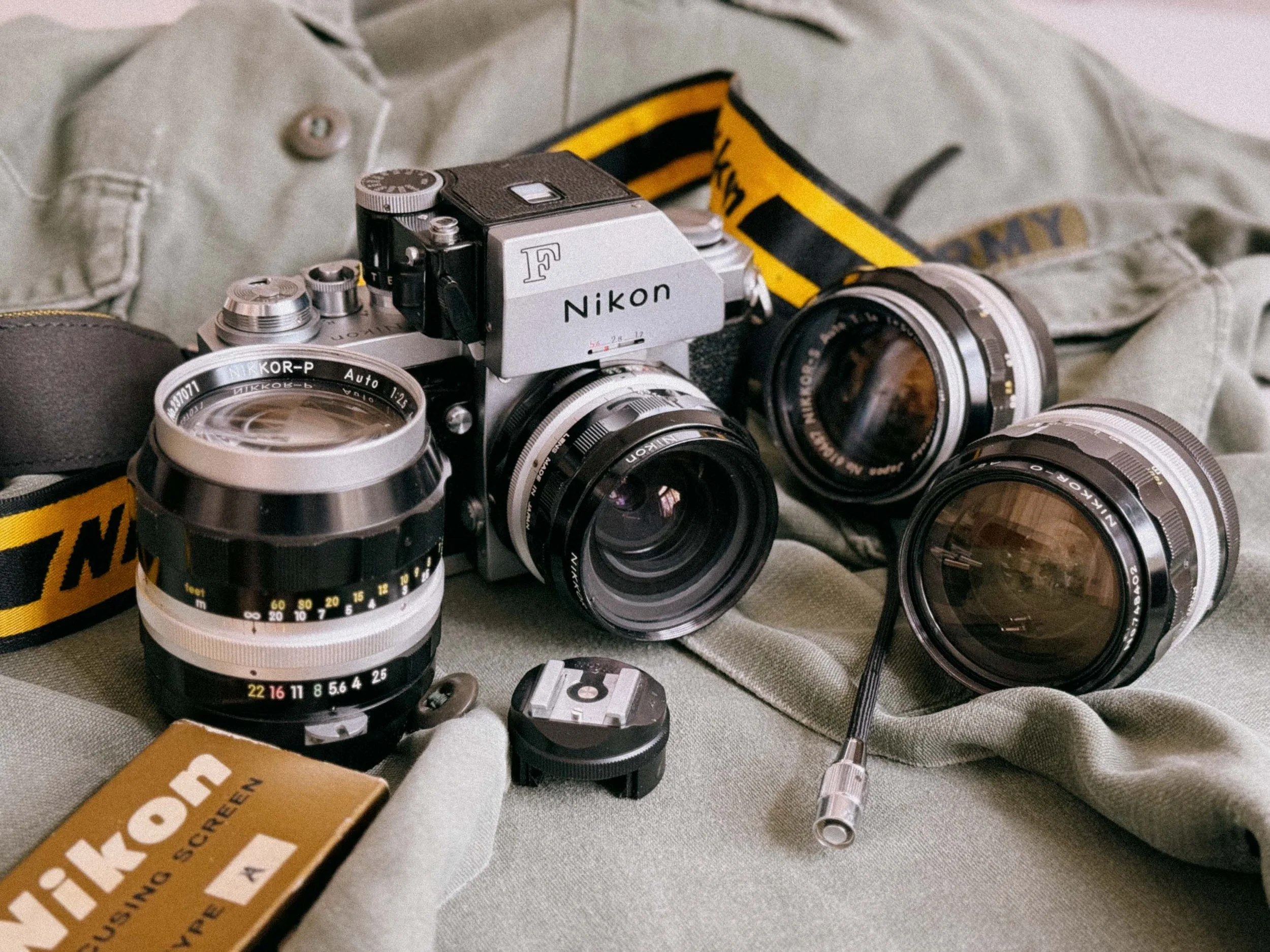
My Nikon F Gear
Today we are surrounded by technology that is designed to be obsolete in three years. The Nikon F is the exact opposite. It is a middle finger to the "disposable" era. It doesn’t have autofocus, it doesn’t have auto exposure, and it certainly won’t help you post to social media.
So, why should you buy one?
Because shooting a Nikon F is a physical experience. You feel the weight of the brass, you hear the mechanical precision of the shutter, and you get to use those legendary Nikkor lenses that are built better than anything on the market today. It’s a camera that demands your respect and your attention. It’s very satisfying to use something that has just as much relevance nowadays as it had when it was introduced almost 70 years ago.
Is it for everyone?
Probably not. It’s heavy, bulky, some say it’s ugly. But it's satisfying and a humbling experience to shoot it. I love it.
Where to buy a Nikon F or F2?
I can only recommend Nikon Classics. Warranty included!
The Bottom Line
The Nikon F is more than just a camera; it’s a time machine. It connects you to the history of photography in a way few other cameras can. If you find a clean body, buy it. If you find a broken one, send it to Hoffmann and they will fix it. In a world of plastic and pixels, the Nikon F remains the heavy weight king.
Nikon F & Nikkor Glass: Full Image Gallery








Going Deeper: The Nikon F Rabbit Hole
While this guide covers the essentials for shooting a Nikon F in 2026, the history of this system is vast. I’ve tried to sum up the knowledge I feel is most important for a modern shooter, but there is so much more to discover. If you’re ready to dive even deeper, these legendary pages are the best places to start:
Nikon's Official F-System Chronicle: A must-read directly from the manufacturer. Absolutely check it out!
Photography in Malaysia (mir.com.my): The absolute encyclopedia of the Nikon F system.
Camera Quest: Great pool of info the Nikon F
Richard de Stoutz: A stunning visual database for identifying specific serial numbers and production changes.
Peter Russel: The ultimate guide on how to clean and adjust the finders.
Downloads
The Nikon F is first modula SLR systems ever made. Original Nikon F manuals remain a great resource for photographers who want to learn how the system works in detail, from interchangeable viewfinders and focusing screens to exposure metering and motor drive compatibility.
Whether you are trying to learn more about the Photomic finder system, or simply love the old school look, i gathered some for you.
Manuals: Original Nikon F instruction manuals covering operation, film loading, exposure metering, and system overview.
→ (link)
Service Manuals: Technical repair and maintenance documentation used by Nikon technicians, including mechanical diagrams and adjustment procedures.
→ (link)
Brochures: Official Nikon marketing materials and product brochures showcasing the F2 system at launch, including specifications and professional positioning.
→ (link)
Enjoyed this? You might also like:
If you found this article helpful, check out my other deep dives into the world of expired emulsions and color recovery:
Rangefinder vs SLR – Canon P vs Nikon F: Two 1959 Classics Compared
Flash Photography with Film Cameras: Manual Flash, Auto Flash & Guide Numbers
Forget the Mju-II: Why the Olympus AF-1 is the Best Point & Shoot Under $100
Mamiya M645 Review (2026): The Best Entry into Medium Format?
FPP Retrochrome 400 Review: Shooting High-Speed Surplus Slide Film
Nikon F2 Review (2026): Is This the Best Mechanical 35mm Camera?
422 Meters of Frozen Gold: The Expired Ektachrome Heist Part I
422 Meters of Frozen Gold: The Expired Ektachrome Heist Part II
Embrace the Blues: Why Ektachrome shifts cooler and how to handle it
Minolta SR-101 (SRT 101) Review: The Ultimate Mechanical SLR in 2026?
Image Credits:
Nikon S2:
Nikon S2 by Katrin Gilger, licensed under CC BY 2.0.

Focusing Screens:
Excerpt from the original Nikon F Instruction Manual (Copyright: Nikon Corporation). Screenshot retrieved from: https://old-cameras.com/2024/04/nikon-f-instruction-manual/4/